
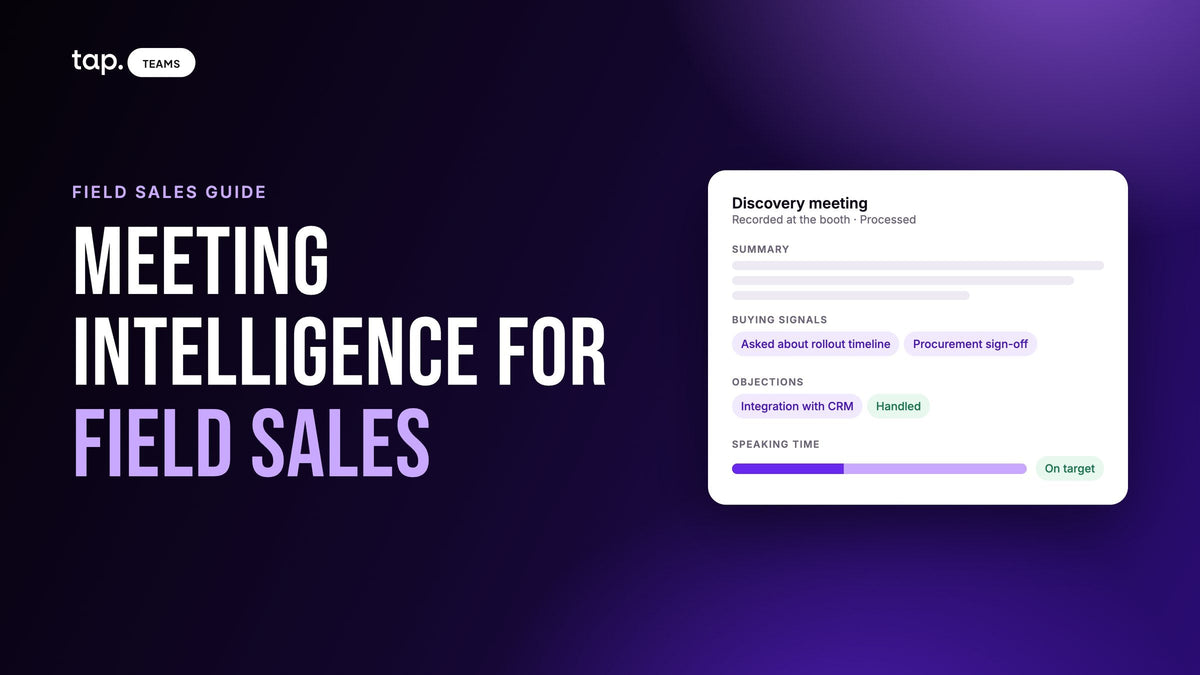
Meeting intelligence is software that records a sales conversation, transcribes it, and turns it into something you can act on: a summary, the topics discussed, buying signals, objections, how much each side talked, and the follow-ups both sides agreed to. It works on video calls, and on face-to-face meetings when the tool records from a phone in the room.
That last part is where most of the category falls down. Nearly every product in this space was designed around the video call, where a bot joins, records, and files a transcript. If your reps sell from a trade show stand or a customer's site office, there's no call for a bot to join, and the conversations that decide your quarter never get recorded. This guide is for teams like that, and it spends most of its time on what the video-call guides skip.
How meeting intelligence works
Whatever a vendor calls it, the software captures the audio, transcribes it with the speakers separated, and reads the transcript to pull out what a rep or manager needs. Then it puts the results where they'll get used, usually the contact's CRM record and a list of follow-up tasks.

For a field team, capture matters most, and it's the step buyers tend to skip past in a demo. There are three common ways to do it:
- A bot joins a scheduled video call as a participant and records it.
- An app on the rep's laptop captures the call audio without a visible bot.
- The rep records on their phone in the room, or uploads a recording made some other way.
Only the third covers a conversation across a desk or at a stand. If a vendor's answer to "how do I record an in-person meeting?" involves a workaround, you know who the product was built for.
Transcription gets more attention than it deserves. Picture a rep on the last evening of a three-day show with a few dozen conversations behind them. They aren't rereading any transcripts. They need the few lines that say why each person mattered and what was promised.
Meeting intelligence vs. conversation intelligence vs. AI note takers
These labels overlap, and vendors stretch them to fit whatever they sell. Here's roughly how they're used:
| Term | What it usually means | Who it's mostly for |
|---|---|---|
| AI note taker | Records and transcribes a meeting, then writes a summary and a list of action items | One person who wants to remember what was agreed |
| Conversation intelligence | Analysis of recorded sales calls, mostly phone and video, with coaching metrics and deal signals | Sales managers coaching inside-sales teams |
| Meeting intelligence | The broader term: analysis of any business conversation, including ones held in person | Reps, managers and enablement looking across a whole team's conversations |
A note taker helps one person remember one meeting. The other two flag signals and objections, measure how much the rep talked, and roll it all up so a manager sees patterns across the team. I say "meeting intelligence" here because most field conversations were never calls.
Why video-call tools miss field sales
Say it's day two of a trade show. A buyer from an account you've been chasing stops by your stand, asks pointed questions about integration, and mentions they're seeing a competitor next month. Ten minutes later the rep is in another conversation. By the evening debrief, what's left is a badge scan and "good chat, follow up."
Or take a pharma rep with a short gap between appointments, talking to a physician in a corridor while the waiting room fills up. Or a sales engineer walking a construction site with the project manager, where the most useful comment of the day gets made next to a generator.
None of these meetings has a video link, and most don't have a calendar invite. The contact details usually get captured fine, especially if you've already sorted out your trade show lead capture. What disappears is the substance, like the competitor that buyer from day two is about to see, or the colleague the physician said you should call. The CRM gets a name and a one-line note, and the follow-up email comes out generic.
Meeting intelligence keeps the conversation attached to the contact, and the conversation is the part you can't rebuild a week later.
What a good analysis should give you
The test I use: does the output answer what a manager would ask if they'd been standing next to the rep? At a minimum, look for these:
| Output | What it tells you | What you do with it |
|---|---|---|
| Summary | What the conversation was about, readable weeks later | Write a follow-up that refers to what was said |
| Topics | The subjects that came up, linked to the moment | Jump straight to the part that matters |
| Buying signals | Moments the buyer moved toward a decision | Decide which leads to call first |
| Objections | Pushback on price, timing, fit, a competitor or an internal blocker | Prepare an answer before the next contact |
| Talk ratio | How much the rep spoke compared with the buyer | Spot reps who pitch when they should be asking |
| Sentiment | How the tone moved through the conversation | Catch an account cooling off before the pipeline shows it |
| Action items | What each side committed to | Turn promises into follow-ups someone can close |
Buying signals are where the money is. A buyer who asks how long implementation takes, or mentions that procurement would have to sign off, is telling you where they are. Reps hear these moments live and rarely write them down, and after a full day on a stand the flags are how they separate warm leads from polite ones.
Objections need a status. One that got answered is a different thing from one left hanging, and when it's time to follow up you want the open ones in front of you.
Action items are the easiest thing to lose. "I'll send you the spec sheet" is a commitment, and if it lives only in the rep's head, some of those won't happen. Once they're tasks, the rep and the manager can both see what was promised and whether it got done.
I'd trust sentiment least on a single meeting and most across an account. An account where every conversation is a little colder than the last deserves a look before the forecast tells you.
All of this should land in the CRM without the rep typing it. People who spend the day in front of customers don't write good CRM notes late at night, and I've stopped expecting them to.
What feeds meeting intelligence
The analysis is only as good as what goes in. Four inputs do most of the work, and the first matters far more than the rest:
- The audio itself, from a bot on a call, an app on a laptop, a phone in the room, or a file uploaded afterward. Noisy or partial audio limits everything downstream.
- What the rep tells the tool before processing: the language of the conversation and the kind of meeting it was. Both change how the transcript and the coaching signals come out.
- The calendar. A tool that can read the rep's calendar can match a recording to the appointment it happened in and take the attendees from the invite, so nobody types them in.
- The contact or CRM record. It tells the tool who the person was, and it's where the summary and follow-ups need to land afterward.
Some vendors also pull in email threads or deal data. That can help on a long inside-sales cycle. For a field team, the honest question is simpler: does the conversation get recorded at all?
Meeting intelligence metrics worth tracking
Every tool shows a dashboard. A few of its numbers are worth a manager's time, and they split into two groups.
Per meeting
- Talk ratio, read against the meeting type rather than one number for every conversation.
- Objections raised, and whether each one was answered before the meeting ended.
- Buying signals, which decide who gets called back first.
- Action items, with an owner on each side.
Across the team
- How many conversations get recorded at all. If this is low, nothing else on the dashboard means much.
- Follow-through: of the commitments made in meetings, how many were done.
- Which objections come up most often, and whether that list changes after you've given reps a better answer.
- Topics climbing week over week.
- Sentiment by account across several meetings, never a single one.
Use the numbers to decide which recordings to listen to. A metric that tells you a rep talked too much in discovery is a reason to open that meeting, not a verdict on the rep.
Why the meeting type changes what good looks like
A discovery meeting and a negotiation are different jobs, and judging them by one standard makes for bad coaching. Take talk ratio. In discovery, the rep should mostly be listening, asking questions and letting the buyer lay out their situation. A rep who does most of the talking in discovery has usually started pitching before they understand the problem. In a demo it's the other way round: the buyer came to see the product, so the rep talks more.
So a useful tool asks what kind of meeting it was before it judges anything. The types that cover most field work are discovery, cold prospecting, demo walkthrough, negotiation and closing, onboarding and training, troubleshooting and support, follow-up, and a general catch-all.
I won't give you a target number. The right range depends on the meeting type and on what you sell, and a benchmark borrowed from someone else's calls says little about your reps. Even with the type set correctly, I'd use the result only to pick which recordings to listen to. Talk ratio measures airtime. A rep who talks through most of every discovery meeting, week after week, has a habit worth fixing that you won't see until something measures it. A rep who ran long once because the buyer asked for a technical walkthrough probably did the right thing.

How reps and managers use it
For the rep, a memory that doesn't fade
The first change is small. Before writing a follow-up, the rep opens the summary, sees the two things the buyer cared about, and writes an email that mentions them. It reads like the rep was paying attention, and they were, because they weren't busy with a notepad.
Asking the recording a direct question, like "what did they say about delivery times?", beats scrubbing through the audio, as long as the answer points back to the moment.
For the manager, coaching without the ride-along
You can't sit in on meetings happening in a dozen places at once. Ride-alongs are expensive, so they're rare, and a rep with their manager in the passenger seat doesn't sell quite the way they do alone. You also can't listen to every recording, and shouldn't try. Coaching signals point to the few worth reviewing, such as a discovery meeting where the rep talked well above the expected range, or an objection nobody answered. Open one of those in your next one-to-one and listen to the minute that matters together. Reps take feedback on something they actually said far better than feedback on a score. Our guide to coaching field reps when you can't sit in on their meetings sets out a weekly routine for this.
Across the team, what the market is telling you
Topics rank what came up across all conversations in a period. They show what prospects actually raise, which often isn't what your marketing assumes. A topic climbing week over week is a market change reaching your reps before it reaches your pipeline reports.
Recurring objections are the most useful view of the lot. One objection in one meeting is a bad day. The same one from many reps is a pattern, and it's either a product gap (roadmap input) or an answer that exists and isn't landing (an enablement problem). They look identical in the data and need different responses. If it's positioning, write the answer once, put it in your enablement material, and check a period later. If the objection is still climbing, the answer isn't working.

Watch the accounts too. One that keeps coming up may be worked by three reps who don't know about each other, and one whose conversations have turned negative or gone quiet belongs on the weekly list.
Then there's follow-through: of the commitments made in conversations, how many got done. Read it next to capture volume. A rep who met a huge number of people at a conference and closed only some of their follow-ups is usually overloaded, and more coaching won't give them more hours. Redistribute leads or protect time for follow-up after events instead.
One caution for all of these views: wait for volume. A topic that shows up in a handful of conversations is noise.
Recording in person: getting audio worth analyzing
Everything downstream depends on the audio, and a trade show floor is about as hard as recording gets. These habits help most:
- Put the phone on the table between you and the buyer. It will pick up both voices far better than a phone in a jacket pocket.
- For the conversations that matter, move to a quieter corner of the stand.
- Use their name early. "Thanks for coming by, Sarah" helps the software separate speakers and makes the transcript much easier to read.
- Set the conversation language before you start. After background noise, it's the biggest factor in accuracy. Conversations that switch languages mid-sentence, which is common in MENA markets, are the hardest case there is.
- Record the whole conversation. Starting halfway through loses the context that makes the summary useful and leaves talk ratio with too little to work with.
And don't record everything. A thirty-second "here's my card" exchange produces a transcript nobody will read, and on most tools it eats into the same transcription allowance as a real conversation.
Consent, privacy and regulated industries
Recording someone requires their knowledge and, in many places, their consent. The rules differ by country and sometimes by state or province, and some require everyone in the conversation to agree. Check where your team sells; this isn't legal advice.
In practice, the rep asks at the start of every conversation. Once at the start of the day doesn't count, and someone who happily let you scan their badge hasn't agreed to be recorded. Something like "Mind if I record this so I don't have to scribble notes? I'll send you a proper summary afterward" gives the buyer a reason to say yes. If they'd rather not, the phone goes away and the rep writes a few lines after.
Before rollout, decide who can see recordings and transcripts, and how you'll delete a person's meetings if they ask to be forgotten. Anything synced to your CRM lives there separately and has to be deleted there too.
Pharma, banking and other regulated industries usually have their own policies on recording customer conversations. Bring compliance in before the first rollout. That conversation is much easier than the one after the first complaint.
Where meeting intelligence falls short
It only knows what was recorded. If reps rarely record, you get activity counts and little else, so adoption decides whether any of this works.
Transcripts from loud rooms have errors, and the analysis inherits them. Treat a ranking of topics or objections as a strong signal, and read a few source conversations before you rebuild your pitch around it.
A lot of a face-to-face meeting isn't words. The buyer glancing at their watch when price came up, or the colleague who wandered over and went quiet: none of that is in the audio, so a rep's own short note after a meeting still earns its place.
And it makes a poor leaderboard. Meeting counts depend on territory and events far more than effort, and ranking people on volume gets you more recordings of worse conversations.
How to choose a meeting intelligence tool for field sales
Most evaluation checklists assume video calls. If your reps sell face to face, ask these in the demo:
- Can a rep record on their phone in the room, with no bot, and can they upload a recording made another way?
- Can you set the conversation language, and what happens when a conversation switches languages?
- Does it judge talk ratio against the meeting type, or against one number for everything?
- Does the summary land on the right contact in your CRM?
- Can a manager see topics, objections and follow-through across the whole team, filtered by department?
- Who can see recordings, and can you delete one person's meetings on request?
Then test it on one of your own recordings from a noisy room. Demo files tend to be clean, and your trade show floor won't be.
Rolling it out to a field team
Buying the tool is the easy part. Getting reps to record the right conversations takes a plan.
- Start with one event or one territory, where conversations are frequent and forgetting them is obviously expensive.
- Agree what gets recorded. Discovery meetings, demos and follow-ups, yes. Quick card swaps, no.
- Teach reps to set the meeting type. A demo tagged as discovery will make a good rep look like they talked too much.
- Write the consent line for them so nobody improvises it at the stand.
- Connect the CRM from day one, and make sure the contacts themselves sync cleanly first. Our guide to turning captured leads into contacts and opportunities covers that part.
- Pick one place where follow-ups get marked done, the meeting tool or the CRM. If reps split between the two, your follow-through numbers mean nothing.
- After that first event, review the team views and tell reps what you learned from their recordings. People keep recording when they see the recordings used.
Here's what that can look like. Say your team comes back from a three-day event with several dozen recorded conversations. Instead of each rep recalling their best leads from memory, the manager opens the objections view, sees the same integration question coming from most of the reps, and has a written answer in the enablement folder before the follow-up emails go out.
How Tap handles this
Tap was built for the conversations a meeting bot can't reach. Reps record in person in the Tap mobile app (iPhone or Android, English or Arabic) against the lead they just captured, or upload a recording they already have. They pick the language and meeting type, and processing runs in the background. Reps who connect Google Calendar get each recording matched to the appointment it happened in, with the attendees taken from the invite.
Each recorded meeting gets a summary, key topics that jump to the moment they came up, buying signals, objections you can mark as handled, speaking time against the target for its meeting type, sentiment, and action items that become follow-ups. When analysis finishes, the summary and action items sync to the lead's CRM record as a task.
For anything the analysis didn't cover, Ask AI takes a plain question, like "What did they say about pricing?" or "Did I commit to anything?", and answers with the timestamped moments it drew from, so you can play them back. Ask in Arabic and it answers in Arabic.
Managers get Team Insights: topics and objections across the team, plus coaching signals, at-risk accounts, sentiment trends and action completion. Recordings are visible to the rep who captured them and to admins.
There's an overview on the Tap for Business page, or you can book a demo and we'll walk through it using your own meeting types.
Related reading
- Talk-to-listen ratio in sales: how much should a salesperson talk?
- Buying signals: how to spot them in a sales conversation
- AI notes for in-person sales meetings (no bot required)
- Field sales coaching: how to coach reps when you can't sit in
- How to track sales objections when your team sells in person
- Sales conversation metrics: what to measure when reps sell in person
FAQ
What's the difference between meeting intelligence, conversation intelligence and an AI note taker?
An AI note taker records a meeting and gives one person a transcript, a summary and action items. Conversation intelligence analyzes recorded sales calls, mostly phone and video, for coaching and deal signals. Meeting intelligence is the broader term and covers any business conversation, including meetings held in person at events and client sites.
Can meeting intelligence work for in-person meetings without a bot?
Yes, if the tool records from the rep's phone instead of relying on a bot joining a video call. The main challenge in person is audio, so keep the phone between both speakers, set the language before recording, and find a quieter spot for the conversations that matter.
Is it legal to record an in-person sales meeting?
It depends on where the meeting happens. Rules vary by country and sometimes by state, and some places require everyone in the conversation to agree. The safe habit is to ask at the start of every conversation and stop if the other person says no. Regulated industries often add their own policies on top.
How accurate are transcripts of in-person sales meetings?
It depends mostly on background noise and on setting the right language before recording. A phone on a table in a quiet corner transcribes well; one in a pocket on a busy show floor doesn't. Conversations that switch languages mid-sentence and unusual product names cause the most errors, though the summary usually still captures the meaning.
Can meeting intelligence replace sales ride-alongs?
Not completely, but it gets you much of what a ride-along is for. You hear how a rep runs discovery and handles objections across far more conversations than you could ever ride along on. Body language isn't in the audio, so an occasional ride-along still has a place.

Leave a comment
This site is protected by hCaptcha and the hCaptcha Privacy Policy and Terms of Service apply.