
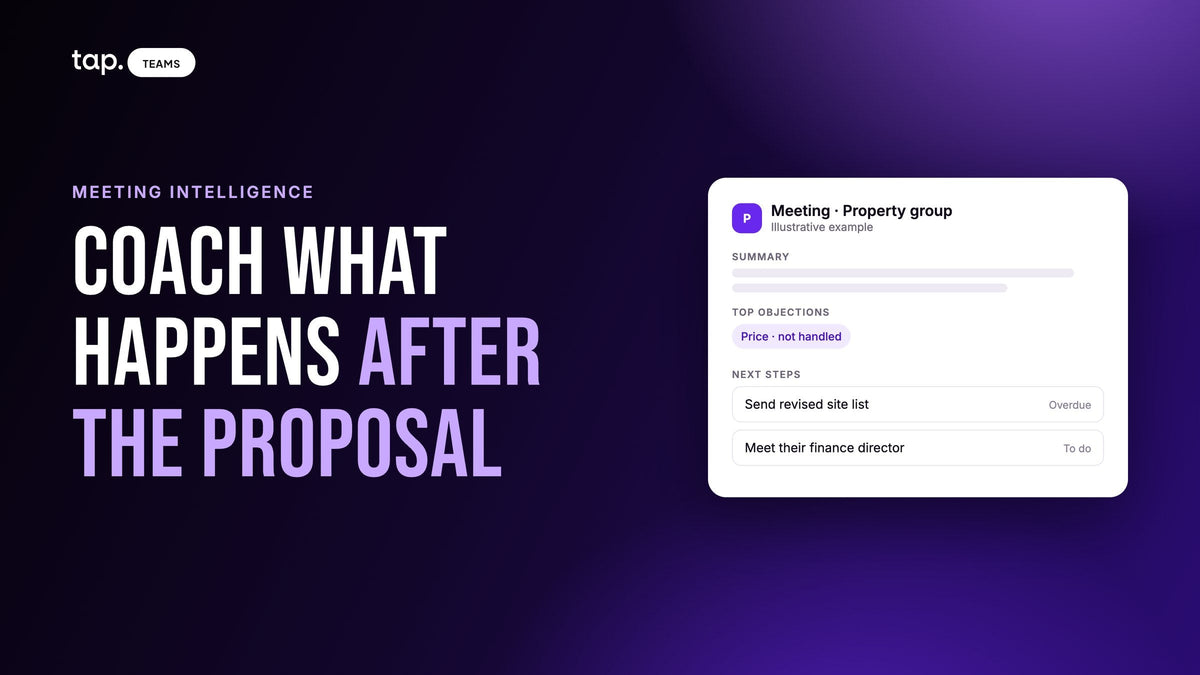
To coach reps on what happens after a proposal goes out, coach what leaves a trace: the next step agreed before sending, what the buyer last said, what each side promised, and whether it got done. Then review every open proposal weekly with better questions than "any news?" and diagnose the silence before anyone chases.
Once a proposal leaves the building, most managers lose the deal. The rep says "they're reviewing it," the CRM says Proposal Sent, and both can stay true for weeks. This article covers that one stretch of the deal. For coaching field reps in general, including the weekly routine and how to run the one-to-one, start with our guide to field sales coaching.
Why the stretch after the proposal goes dark
Before the proposal, there are meetings. The rep is in the room, and things get said. After it, the decision moves to people the rep may never have met: the buyer's director, finance, procurement. So the rep can't see much either, and that changes what coaching can do here. When you ask "what's happening with that deal?", you're asking about something your rep often doesn't know. "They're reviewing it" is usually an honest answer.
Field selling takes away more. There's no email thread from the meeting where the buyer asked for the proposal, and the reason they asked lives in the rep's memory. If the rep walked through the numbers in the buyer's office, nobody else heard how that went.
Tools that report when a document was opened help a little. An open tells you someone looked. It can't tell you what they said about it afterward, and it goes blind once the buyer saves a PDF and forwards it around the building. I wouldn't build coaching on it.
What you can see, and what it's good for
| Source | What it tells you | What it won't tell you |
|---|---|---|
| CRM stage and close date | A proposal went out, and the date the rep typed in | Whether the buyer is moving |
| Document opens, if you have them | Someone looked, and when | Who talked about it, and what they said |
| Recording of the last meeting | The buyer's words on price, timing and who decides | Anything that has happened since |
| The rep's notes | What the rep thought mattered, and any contact since | What the rep missed |
| Open commitments | What each side promised, and whether it got done | How much the buyer cares |
The last three are where the coaching is. If the meetings around your proposals aren't recorded, fix that first, with the buyer's agreement each time. Meeting intelligence for in-person conversations is one way to do it, and our guide for field sales covers the options and the consent side.

Coach the meeting before the proposal
Most of what goes wrong after the proposal was settled before it went out. A buyer says "send me something," the rep is pleased to be asked, and the meeting ends. From then on the rep is waiting, with nothing agreed to hold anyone to.
Before a proposal goes out, a rep should be able to answer these:
- Who else has to say yes, and have we met them?
- What will the buyer do with this when it arrives?
- When do we go through it together, and is that in both calendars?
- Why would they decide by a certain date, in their own words?
The practical move is small. When the buyer says "just send me a proposal," the rep says: "Happy to. Can we take half an hour next Tuesday to go through it, and is there anyone else who should be there?" If the buyer won't give a date, the rep has learned something, and it should change how the deal gets forecast.
This is the easiest part of the stretch to coach, because you can hear it. Listen to the last ten minutes of the meeting before the proposal with your rep, and ask what they'd do differently. My rule would be simple: no proposal goes out without a dated next step on the buyer's side, or a note saying why there isn't one.
Better questions than "any news?"
"Any news?" gets you "they're reviewing it." These five are answerable from what the rep already knows, and each one points at something you can coach:
- What did they agree to do, and by when?
- Who besides your contact is reading it, and what do you know about them?
- What was the last thing they said about price?
- What did we promise them, and have we done it?
- Why do you think they've gone quiet, and what's that based on?
The last question matters most. A rep who says "I think finance is pushing back, because she mentioned the budget twice" has a theory you can test. A rep who says "no idea" needs you to go back to the recording with them. Keep the tone curious. Reps who get grilled over a quiet buyer learn to report that everything's fine.
Diagnose the silence before anyone chases
More follow-ups don't help when the rep doesn't know what the silence means, so work it out in order. Sometimes the answer is to do nothing.

At the last step, the buyer's words usually tell you what to coach. Our article on deal risk signals covers the signs themselves; here's how they turn into a coaching conversation:
| What the buyer last said | What's probably going on | What to coach |
|---|---|---|
| "I'll run it past my director" | Your contact has to sell it for you, without you there | Offer to walk the director through it, with the contact, and give them a short version they can pass on |
| "It's more than we expected" | Price is still open, and the proposal didn't close it | Raise it directly and ask what they're comparing it to, before any talk of a discount |
| "We're looking at a few options" | A comparison is under way, and you may not know the criteria | Ask what they liked elsewhere and what would decide it |
| "Probably after budget season" | The deal lost its deadline | Agree on a new date, and move the forecast to match |
| "Looks great, leave it with me" | Polite, and you learned nothing | Go back to the recording: what did they ask, and what did they commit to? |
Coach the follow-up itself
Ask to see the message before it goes. The test is whether it gives the buyer a reason to reply beyond the rep wanting one.
The weak version: "Just checking in on the proposal. Any thoughts?"
A stronger one uses what the buyer said in the meeting: "You mentioned your current contract ends in March. To be set up before then, your team would need to decide by the end of January. Is that still the plan, or has it moved?" The buyer can answer that in one line, and either answer tells the rep something.
Field reps also have a move inside reps don't: they can turn up. "I'm at the site next door on Thursday. Could I take ten minutes with you and your finance lead to go through the numbers?" A short visit with a reason attached can get the rep in front of the person they've never met. Ask your reps when they last did this on a quiet deal.
Agree on when to stop, too. A dead proposal left open makes the pipeline look healthier than it is. A straight question often gets the first honest answer in weeks: "It sounds like this isn't a priority right now. Should I check back after budget season, or close it on my side?"
An example review
Say a rep sells maintenance contracts to a property group. The proposal went out three weeks ago and the CRM still shows it closing this month. In the one-to-one, the manager asks what the buyer agreed to do. The rep pauses: "She said she'd come back to me." There's no date.
They open the recording of the last meeting and go to the end. The buyer says she'll need to take it to the finance director, and the rep says "great, I'll send it over." Hearing it, the rep spots the problem before the manager says a word. The note from that meeting also shows the rep promised a revised site list, which never got sent.
So there's one move this week: send the site list, and use that message to offer to go through the numbers with the finance director. The close date moves until there's a real one, and the manager listens to the end of the rep's next meeting.
Making it a weekly habit
Keep one list of open proposals, each with the date it went out, the next step and who owns it. Go through it with each rep for ten minutes in the one-to-one you already hold.
Once a month, take a couple of lost proposals and go back to the meeting before each one. You're looking for what you could have heard at the time. Patterns show up quickly, such as proposals sent with no second contact on the buyer's side.
How Tap handles this
In Tap, reps record in-person meetings on their phone against the lead, or upload a recording they already have. Each one gets a transcript, a summary, key topics, buying signals, top objections and speaking time; the meeting intelligence page shows what comes out. Commitments made in the conversation, like "I'll send the pricing," become follow-ups without anyone taking notes, and they sync to the CRM as tasks. A rep can attach files to a follow-up, so the proposal they sent sits next to the fact that they sent it. For conversations nobody recorded, a rep can add a task to a note, with a due date and a reminder.
Ask AI answers questions about a recorded meeting, such as "Did I commit to anything?" or "What did they say about pricing?", and cites the moment so you can play it. It can draft a follow-up email from what was said, which the rep reads, edits and sends themselves. On enterprise plans it can search every meeting you have permission to see, so you can ask what an account has said across several meetings.
For managers, action completion shows per person how many commitments were marked done. Team Insights lists at-risk accounts, meaning accounts whose conversations have turned negative or gone quiet, and flags notes where something was promised and nothing has been logged since. Coaching signals surfaces patterns in individual conversations worth reviewing with the rep.
All of it comes from what the team records, writes down and marks complete, so it won't show you a conversation in the buyer's office that the rep wasn't part of. A follow-up that got done but never ticked looks undone, so agree on where completion gets recorded. Some of the team-level views are on the Enterprise plan.
You can book a demo and we'll walk through it with a few of your own open proposals.
FAQ
How do I coach my sales team when I can't see what's happening after they send proposals?
Coach from what you can see: the meeting before the proposal, the buyer's last words, and what each side promised. Make sure every proposal goes out with a dated next step, review open proposals weekly with specific questions, and work out why a buyer has gone quiet before the rep follows up.
What should a manager ask in a proposal review?
Ask what the buyer agreed to do and by when, who else is reading it, what they last said about price, what your side promised and whether it's done, and why the rep thinks the buyer has gone quiet.
How long should a rep wait to follow up after sending a proposal?
Agree on the date with the buyer before sending, and follow up on that date. If there's no date, don't wait for a set number of days. Send a message with a reason to reply, tied to something the buyer said, and treat the missing date as the thing to fix on the next deal.
What do you do when a prospect goes quiet after a proposal?
Check whether a dated next step is still ahead; if it is, wait. Then check that your side has done what it promised. After that, look at what the buyer last said, since that usually points at the cause: an internal decision-maker, price, a comparison or timing. Address that cause directly, and if a straight question gets no answer, close it out and move the forecast.


Leave a comment
This site is protected by hCaptcha and the hCaptcha Privacy Policy and Terms of Service apply.