
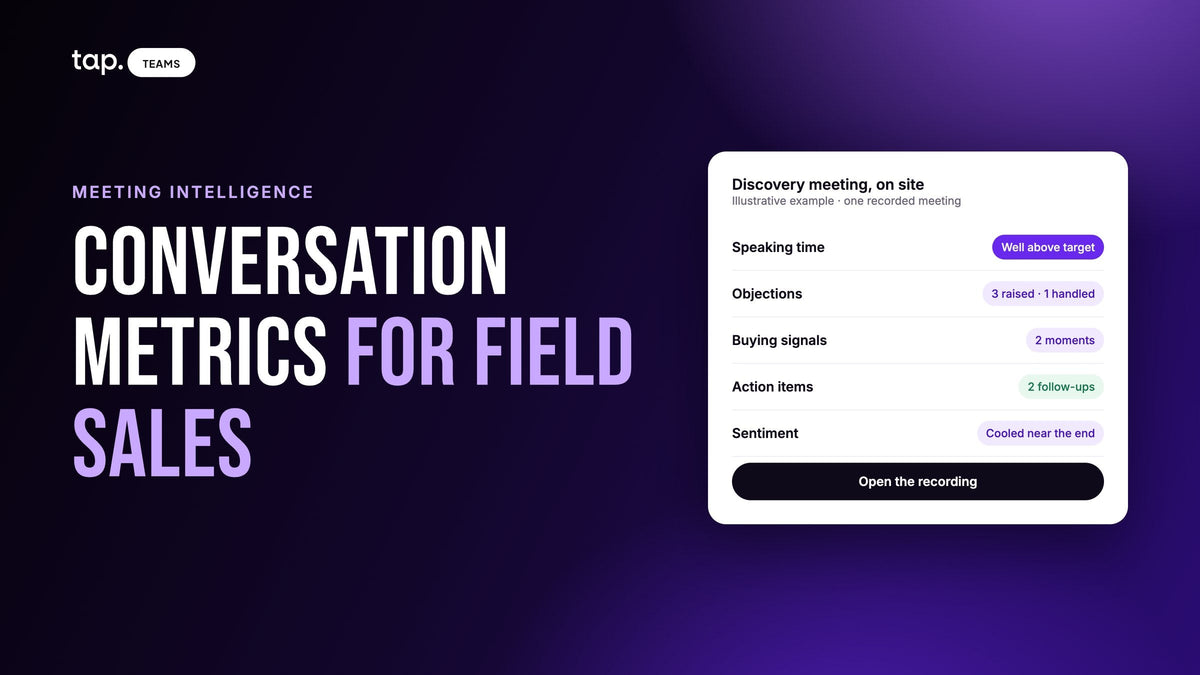
The sales conversation metrics worth measuring are talk ratio, question rate, longest monologue, objections raised and handled, buying signals, and whether a next step was agreed. Read them by meeting type, against your own best reps rather than borrowed benchmarks, and check them against outcomes like follow-ups completed and deals that moved.
Most lists of sales call metrics were written for teams on a dialer: calls per day, connect rate, average call length. Those count activity, not what happened once the buyer started talking, and they barely apply to a rep who spends the day in clinics, site offices and trade show halls. This article covers the metrics that describe the conversation itself, and what changes when it happens across a table. For the wider picture of recording and analyzing field meetings, start with our meeting intelligence guide for field sales.
Three kinds of sales call metrics
It helps to sort metrics into three layers before picking any of them.
Activity metrics count how much selling happened: meetings held, calls made, meetings recorded. For a field team they mainly tell you how much evidence you have. A rep who recorded two meetings this month can't be judged on conversation metrics yet.
Conversation metrics describe what happened inside a meeting: who talked, how much, what was asked, what the buyer pushed back on, and where they leaned in. This is the layer you can coach, because a rep can change it in their very next meeting.
Outcome metrics tell you whether it worked: a next step agreed, follow-ups done, a deal that moved forward, won or lost. They arrive too late to coach from on their own.

The mistake to avoid is coaching on layer two with targets nobody has checked against layer three.
The conversation metrics worth measuring
Talk ratio
The share of the meeting the rep spent speaking. It's the metric everyone starts with because it's easy to see, and it's genuinely useful for one thing: catching reps who pitch when they should be asking. The right share depends on the meeting. In discovery the buyer should do most of the talking; in a demo the rep will talk more. I won't give you a number, because a target borrowed from someone else's phone calls says little about your reps in a customer's office. Our article on the talk-to-listen ratio covers how to calculate it and how to set ranges from your own team.
Question rate
How many questions the rep asked, scaled to the length of the meeting so a short meeting and a long one can be compared. Count the questions in the transcript, divide by the meeting length in minutes, and multiply by 60 for a per-hour rate. Nine questions in a 27-minute meeting works out to 20 an hour. That's arithmetic, not a target.
The count is the easy part. What matters is what kind of questions they were. Open questions that get the buyer explaining their situation ("How do you handle that today?") are discovery. Closed questions that confirm a fact are fine in small doses. Three questions stacked into one breath get one answer, usually to the last of them, so count a stack as one. And a question the rep answers themselves before the buyer can speak isn't a question at all.
A high question rate can also mean the buyer felt interrogated, which is why it's only useful next to talk ratio.
Longest monologue and longest customer story
The longest stretch the rep spoke without the buyer saying anything, and the longest stretch the buyer spoke. A long rep monologue in discovery is usually a pitch that started too early. A long customer story is often the best moment of the meeting: one good question got the buyer describing a real problem in their own words. Both are easy to find in a transcript that separates speakers, the kind a meeting intelligence tool gives you, and both point you to the exact minute worth listening to.
Objections raised, and how many were handled
Counting objections tells you little. Counting the ones left open tells you a lot. A meeting where the buyer raised three concerns and the rep answered all of them is a better meeting than one with a single objection left hanging. The method for logging them is in our guide to tracking sales objections.
Buying signals
Moments when the buyer moved toward a decision: asking about implementation time, who else would need to sign off, or what happens after a trial. Reps hear these live and rarely write them down. What matters is whether they happened, and whether the rep answered with a proposed next step.
Next step agreed
Did the meeting end with something specific: a date, a person, an action? "I'll send some information" is not a next step. "We'll meet your finance director on Tuesday" is. It sits closest to outcomes of anything here.
Sentiment
How the tone moved through the meeting. I'd trust it least on a single meeting and most across an account. An account where every conversation is a little colder than the last deserves a look before the forecast tells you.
How to analyze talk ratio and question rate together
Each number alone is ambiguous. A rep who talks a lot might be pitching or answering a technical question the buyer asked. Read side by side, the two narrow it down:

To turn that into a routine:
- Split meetings by type first. Discovery, demos, negotiations and follow-ups each get their own baseline. Mixing them produces an average that describes none of them.
- Build the baseline from your own deals. Take the meetings of reps whose deals move, one meeting type at a time, and look at where their numbers sit. That's your range.
- Look for patterns across weeks, not single meetings. One long-winded discovery meeting is a bad day. The same shape every week is a habit.
- Open the recording before you say anything. Play the minute with the rep and ask what they'd do differently.
- Coach one thing at a time. A rep handed five metrics to fix will fix none of them.
For running that conversation with reps you can't ride along with, see our guide to field sales coaching.
What changes when the meeting is in person
Almost every guide to these metrics assumes a recorded phone or video call. Field meetings break a few of those assumptions, and the metrics need adjusting for them.
Your sample is what reps chose to record
On a phone team every call is recorded. In the field, reps decide, and they tend to record the meetings they expect to go well. Before reading any conversation metric, check how many of a rep's meetings were recorded at all. A rep with great numbers on a handful of chosen meetings tells you less than one with average numbers on most of them. Agree up front which meetings get recorded (discovery, demos, negotiations) so the sample means something.
Groups change the arithmetic
Across a table from three people on the buyer's side, the conversation moves between them. Count everyone on their side together as "the buyer" for talk ratio, or a meeting with a buying group will look like the rep never spoke. And only count the rep's questions toward question rate. A procurement lead asking your rep ten questions is a different meeting.
Short and noisy meetings give bad numbers
A six-minute conversation at a trade show stand gives a per-hour question rate that means nothing, and a recording made on a busy show floor separates speakers less reliably. Set a minimum length before a meeting counts toward anyone's metrics, and leave out recordings too noisy to trust. A metric built on a bad transcript looks precise and isn't.
Some of the meeting isn't in the audio
The buyer who checked their watch when price came up, or the colleague who walked in and went quiet, won't show up in any number. A short note from the rep after the meeting still earns its place next to the recording.
Metrics that look useful but mislead
| Metric | Why it's tempting | Why it misleads |
|---|---|---|
| Meetings recorded, ranked by rep | Easy to count | Depends on territory and events far more than effort, and reps learn to record anything to climb the list |
| Average meeting length | Looks like engagement | Set by the buyer's diary, not the rep's skill |
| Filler words and speaking pace | Software counts them for free | Rarely the reason a deal stalls, and coaching them makes reps self-conscious |
| Sentiment score on one meeting | One number per meeting | Swings with mood and noise; useful only as a trend across an account |
| One talk-ratio target for every meeting | Simple to report | Penalizes good demos and rewards quiet discovery meetings that learned nothing |
The test for any metric: can a rep change it in their next meeting, and does changing it link to deals moving in your own data? If the answer to either is no, it's reporting, not coaching.
Connect the conversation to outcomes
Conversation metrics earn their keep only if they line up with results. Every quarter or so, pull the recorded meetings from deals you won and deals you lost, one meeting type at a time, and compare. Did won deals have more open objections handled in discovery? Longer customer stories? A next step agreed in the first meeting? Whatever separates them in your data is what to coach, and it may not be what the vendor blogs say.
Then watch follow-through. A meeting can go perfectly and still produce nothing if the rep never sends what they promised. Of the commitments made in meetings, how many were actually done? Read that next to how many meetings each rep had. A rep who met dozens of people at a conference and closed only some of their follow-ups is usually overloaded, and more coaching won't give them more hours.
Say a manager notices that in won deals, discovery meetings almost always ended with a named next step, and in lost ones they mostly didn't. That's one habit to coach, one question to ask reps after each meeting, and one thing to check again next quarter. It's more useful than a dashboard of twelve numbers.
How Tap handles this
In Tap, reps record in-person meetings on their phone against the lead they're talking to, or upload a recording they already have, and set the meeting type: Discovery, Cold prospecting, Demo walkthrough, Negotiation and closing, Onboarding and training, Troubleshooting and support, Follow-up, or General. The type decides which talk-ratio target the analysis uses, and it can be changed afterwards.
Each recorded meeting gets speaking time measured against that target, with a result of On target, Above target, Well above target, Below target, or Not enough data when the recording is too short or unclear to judge. The same analysis gives a summary, key topics, buying signals, top objections you can mark as handled, and sentiment, and action items become follow-ups. The transcript separates speakers, so you can read the rep's questions and the buyer's longest answers yourself. Ask AI answers your own questions about a meeting and cites the timestamped moment so you can play it.
For managers, Team Insights rolls topics and objections up across the team's recorded meetings, with coaching signals, sentiment trends and at-risk accounts. Action completion shows, per person, how many of the commitments made in meetings were marked done. Insights are built from recorded meetings, so a team that rarely records will see little. Recordings and transcripts are visible to the rep who captured them and to admins.
You can see how it works on the meeting intelligence page, or book a demo and we'll walk through it with your own meeting types.
FAQ
What metrics indicate a high-performing sales call?
Look for a talk ratio that fits the meeting type, open questions that got the buyer explaining their situation, a long customer story, objections answered rather than left open, buying signals followed up, and a specific next step agreed. Confirm what "high-performing" means for your team by comparing meetings from won and lost deals.
What are the most important sales call metrics?
For coaching, the conversation metrics: talk ratio by meeting type, question rate, longest monologue, objections handled, and next step agreed. Activity metrics tell you how much selling happened and outcome metrics whether it worked, but you coach on the conversation.
What's the best way to analyze talk ratio and question rate in sales calls?
Read them together, one meeting type at a time. High talk with few questions usually means pitching; low talk with many questions is either good discovery or an interrogation, depending on the questions. Set ranges from your own best reps, look for patterns across weeks, and open the recording before coaching.
What metrics can you get from a sales call transcript?
With speakers separated, a transcript gives you talk ratio, question count and rate, the longest rep monologue and customer story, objections and whether they were answered, buying signals, competitors mentioned, commitments made by each side, and how the tone moved. Noisy recordings make all of these less reliable.
How do you measure sales conversations that happen in person?
Record the meeting on a phone placed between the rep and the buyer, with their agreement, then transcribe it with speakers separated. Count everyone on the buyer's side together, set a minimum meeting length before metrics count, and check how many meetings each rep recorded before comparing their numbers.

Leave a comment
This site is protected by hCaptcha and the hCaptcha Privacy Policy and Terms of Service apply.