
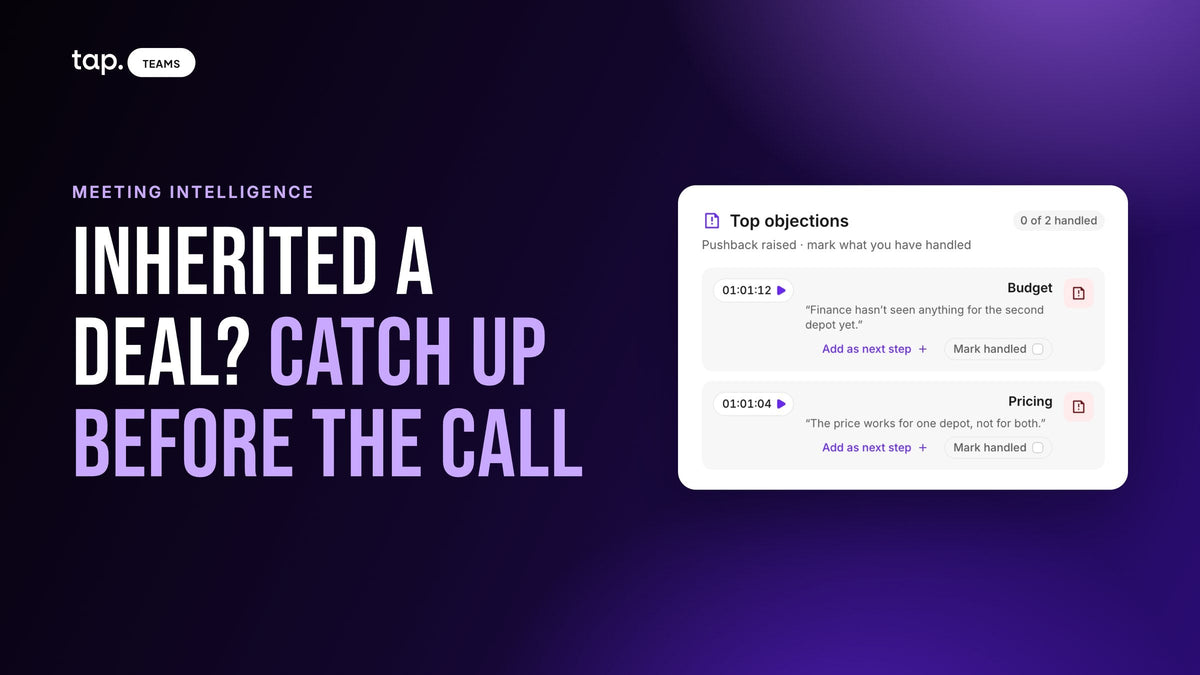
To catch up on an inherited deal before your first call with the buyer, rebuild the history from the record before you talk to anyone: the last meeting, what each side promised, who's involved and where it stands. Fill the gaps with colleagues who are still here, then use the call to confirm what you know rather than restart discovery.
Most advice on account handovers is written for the manager, and it assumes the departing rep is still around for a handoff meeting and a tidy note. If you're reading this, that ship has probably sailed. Your colleague has left, the deal is in your name, and the buyer is expecting a call from someone they've never met. This is a prep routine for that situation, in the order I'd do it.
What changes when the rep has already left
In a live handover, the useful part is what the rep says out loud: "she's keen but her boss isn't," "I promised them a site visit." Once they've gone, that's lost unless somebody wrote it down or recorded it.
So you're working from three things: whatever the record holds, the people inside your company who touched the deal, and the buyer. Use them in that order. Every question you can answer from the record is one you don't have to ask the buyer, and buyers notice when they have to explain their own project twice.

Day one: get the deal properly into your name
Before you read anything, make sure you can see everything. This part is dull, and skipping it is how you find a second open quote three weeks later.
- Check the opportunity, the account and every contact on it are owned by you in the CRM, not left with the departed rep or a default owner.
- Ask your manager or admin whether the rep owned other records at the same company: a second opportunity, a contact at another branch, a lead captured at an event and never converted.
- Find out if the rep kept anything outside the company's systems, such as a personal CRM login, a spreadsheet, or files on their own drive. If they did, someone needs to retrieve it before the account is closed.
- Pull the open proposals and quotes, with the versions and dates. You need to know exactly what the buyer was last shown.
Tell your manager what's missing. They can chase things you can't, like the old rep's mailbox.
Read the record in the right order
Don't start at the first activity and read forward. Start with the most recent conversation and work backward, because what the buyer said last matters more than what they said six months ago.
| Source | What to look for | What it won't tell you |
|---|---|---|
| The last meeting (recording, summary or notes) | What the buyer last said about price, timing and who decides, and the next step agreed | Anything that has happened since the rep left |
| Open tasks and follow-ups | What your side promised, what's overdue | Promises made out loud and never logged |
| Proposal or quote | The exact scope and price on the table | How the buyer reacted to it |
| Earlier meetings and notes | Why they started looking, objections raised, competitors named | Whether any of that still holds |
| CRM stage and close date | What the rep believed, and when | Whether the buyer agrees |
Keep two lists as you go: what the record confirms, and what you still can't answer. The second list is your prep for colleagues and the buyer.
Field deals: the history lives in meetings, not the inbox
If the deal was sold over email and video calls, you can rebuild a lot from the thread. Field deals are different. The pricing conversation happened across a desk in the buyer's office. The decision-maker was the person who walked in halfway through the second visit. The promise was "I'll bring the engineer next time," said at the door. The email thread might only hold meeting confirmations and a PDF.

So for a field deal, the meeting record is the handover. If your team records in-person meetings with the buyer's agreement, read or listen to the last one in full before anything else, and skim the summaries of the ones before it. Meeting intelligence for in-person sales is built for exactly this kind of record, and our guide to meeting intelligence in field sales covers how teams set it up and handle consent.
Find the open promises, on both sides
The fastest way to lose an inherited deal is to walk into the call without knowing what your company owes the buyer. A rep who leaves often leaves a promise half kept: a revised quote, a reference customer, a trial unit, an answer from the product team.
Go through the last two or three meetings and notes and write down every commitment, with who made it and whether it got done. Do the same for the buyer's side. Did they say they'd share a spec, book time with their finance lead, or get back to you by a date? We wrote about what to coach after a proposal goes out, and the same rule applies here: the dated next step on the buyer's side tells you more about the deal than the stage does.
If something on your side is overdue, fix it before the call. A revised quote sent the day before says more than an apology.
Map who's involved
Write down every person on the buyer's side who appears in the record, and for each one note what they seem to care about and how much say they have. Look at who attended each meeting, who was mentioned but never met, and who asked the hard questions.
You're looking for the gaps. A deal where your colleague only ever met one friendly contact is weaker than its stage suggests. Our piece on buying roles in B2B sales covers how to place people as decision-maker, influencer, end user or gatekeeper from what they say in the room.
Talk to the people still in the building
Before you call the buyer, spend half an hour with whoever else touched the deal: your manager, a solutions engineer, whoever priced the job. Useful questions:
- What did the rep say about this deal in pipeline reviews?
- Was anything agreed on price or terms that isn't in the quote?
- Has anyone from our side spoken to the buyer since the rep left?
- Is there anything about this customer I should know before I call?
The third question matters more than it looks. If the buyer already got a call from your manager or a support colleague, you need to know what was said.
If the departed rep left on good terms and isn't at a competitor, a short call with them can fill gaps nothing else will. Check with your manager first, and don't build your plan on it.
Re-qualify before you forecast it
The stage and close date were your colleague's opinion, and departing reps don't always keep them current. Treat the deal as unqualified until the record or the buyer tells you otherwise.
Ask yourself whether you can answer these from what you've read: why they're buying, why now, who signs, what they're comparing you with, and what happens next on their side. Anything you can't answer goes on the call list. Then look at how the last meeting ended. The deal risk signals you can hear in a conversation, such as a buyer who stopped naming dates or went quiet on price, often explain why a deal was stalling before anyone left.
If the deal is earlier than the CRM says, move it now. Forecasting it down in week one is easier than explaining a slip in month two.
Write a one-page brief
Put what you know on one page. You'll use it on the call, and your manager will want it anyway.
- Why they're buying, in the buyer's own words if you have them
- Who's involved, and who you haven't met
- What's on the table: scope, price, version and date of the last quote
- What we owe them, and what they owe us
- Where the last meeting ended, and the agreed next step
- What you still need to find out
Then send the buyer a short note: who you are, that you've taken over and read the history, and one specific thing you've already done for them. Save the rest for the call.
How to open the first call

Open by summarizing what you know, and ask the buyer to correct you. Something like: "Before we go further, let me tell you what I've picked up, and you tell me what I've got wrong. You're replacing the system at your two warehouses before your current contract ends, your operations director has the final say, and the last thing we owed you was a revised quote with the second site included. I sent that yesterday."
That shows you did the reading, lets the buyer correct the record easily, and puts your side's promise up front. Then ask what's changed since they last spoke to your colleague. Something always has.
Leave the call with one dated next step on their side, and ideally a reason to meet in person. On a field deal, a visit to the site is the fastest way to become the person they deal with now.
When there's no record at all
Sometimes there's only a stage, a contact name and a close date. Then say so to the buyer. "My colleague's notes don't cover much of what you discussed, and I'd rather hear it from you than guess. Could you give me fifteen minutes on where things stand?" Most buyers respect that more than a confident guess.
Then fix it for whoever comes after you. If your team doesn't capture in-person meetings today, start with something light, like AI notes for in-person meetings, so the next handover has something to hand over.
An example
Say you sell fleet maintenance contracts and inherit a deal with a logistics company after your colleague left on short notice. The CRM shows the deal at the negotiation stage, closing this month.
In the last meeting, the buyer says the price works for one depot but must cover the second before her finance director will look at it. Your colleague promises a revised quote. That follow-up is still open, two weeks overdue, and no earlier note shows the finance director at a meeting.
So you send the revised quote the day before the call. On the call you confirm the two-depot scope, ask whether the finance director has seen anything, and offer to walk him through the numbers in person. You move the close date out a month, because nobody with sign-off has seen the price.
How Tap handles this
When an admin removes a member in Tap, their leads and the meetings they recorded stay with the company, and the admin reassigns those leads to whoever picks up the accounts. The docs also suggest checking whether the leaving rep had a personal CRM connection, and exporting those leads first if so. Recordings and transcripts are visible to the member who captured the lead and to admins, so if your former colleague recorded the meetings, go through them with an admin.
A lead carries what was captured, the notes, the attached meetings and the follow-up history. Notes include what the rep typed, what the buyer wrote on the capture form, and voice notes, which are transcribed and summarized. Each recorded meeting has a transcript that shows who said what, a summary, key topics, buying signals, top objections and the action items, which become follow-ups. The meeting intelligence page shows what a meeting looks like. In Companies you can open the buyer's company and see every lead there and who on your team captured them, which helps when the rep met more people than the CRM shows.
For a quick catch-up, Ask AI answers questions about a recorded meeting, such as "Did I commit to anything?" or "Which objections did I leave unhandled?", and cites the moment in the recording so you can play it. If nothing in the conversation answers the question, it says so. Your questions are private to you.
It only covers what the team recorded or wrote down, so a promise made at the door after the recording stopped won't be there. You can book a demo to see it on a deal like yours.
FAQ
How do I catch up on a deal I inherited from a colleague who left?
Make sure the deal and every related contact are in your name, then read the record backward from the last meeting. List what each side promised, who's involved and what you can't answer. Fill gaps with colleagues who touched the deal, write a one-page brief, and open the buyer call by confirming what you know.
What should be on an account handover checklist in sales?
Ownership of the account, opportunity and contacts; open proposals and quotes with versions; any records the rep kept outside company systems; the last meeting and its next step; open commitments on both sides; a map of who's involved on the buyer's side; and who tells the customer about the change, and when.
What do you say to a customer when you take over their account?
Introduce yourself, say you've taken over from your colleague and read through the history, then summarize what you know and ask them to correct it. Deliver anything your side still owes them, ask what has changed, and agree a dated next step.
Should I contact the rep who left about the deal?
Only if they left on good terms, aren't working for a competitor, and your manager agrees. Keep it short and about the deal. Treat what they tell you as one more source to check against the record.


Leave a comment
This site is protected by hCaptcha and the hCaptcha Privacy Policy and Terms of Service apply.