
Meeting notes record what happened in one conversation: what was discussed, what each side agreed and what happens next. Conversation intelligence analyzes many conversations together to find what repeats, such as topics, objections, shifts in sentiment and coaching moments. Notes help one person remember one meeting. Conversation intelligence helps a manager understand what a whole team is hearing.
The two get blurred because the tools have moved toward each other. AI note takers now pull out action items and the odd buying signal, and every conversation intelligence product writes a summary. A better test than the label is what the tool does with your fiftieth meeting that it couldn't do with your first, and that's what this article works through, with the in-person and trade show cases most guides skip. For the wider category, including where the term "meeting intelligence" fits, see our meeting intelligence guide for field sales.
What meeting notes are
Meeting notes are a record of a single conversation, and they come in two forms. Manual notes are what the rep writes, during the meeting or after it. They capture what the rep thought mattered at the time, plus things a microphone can't hear, like who seemed to be in charge or how the buyer reacted when price came up. They also miss a lot, because nobody can write fast and listen well at once.
AI notes come from a recording. A note taker transcribes the conversation, separates the speakers, and writes a summary and a list of action items. You get the buyer's exact words and every commitment, without the rep splitting attention between the buyer and a notepad. Our article on AI notes for in-person sales meetings covers how to get good ones when there's no video call for a bot to join.
Either way, the unit is one meeting. Ten meetings later you have ten good records and nothing that reads across them.
What conversation intelligence is
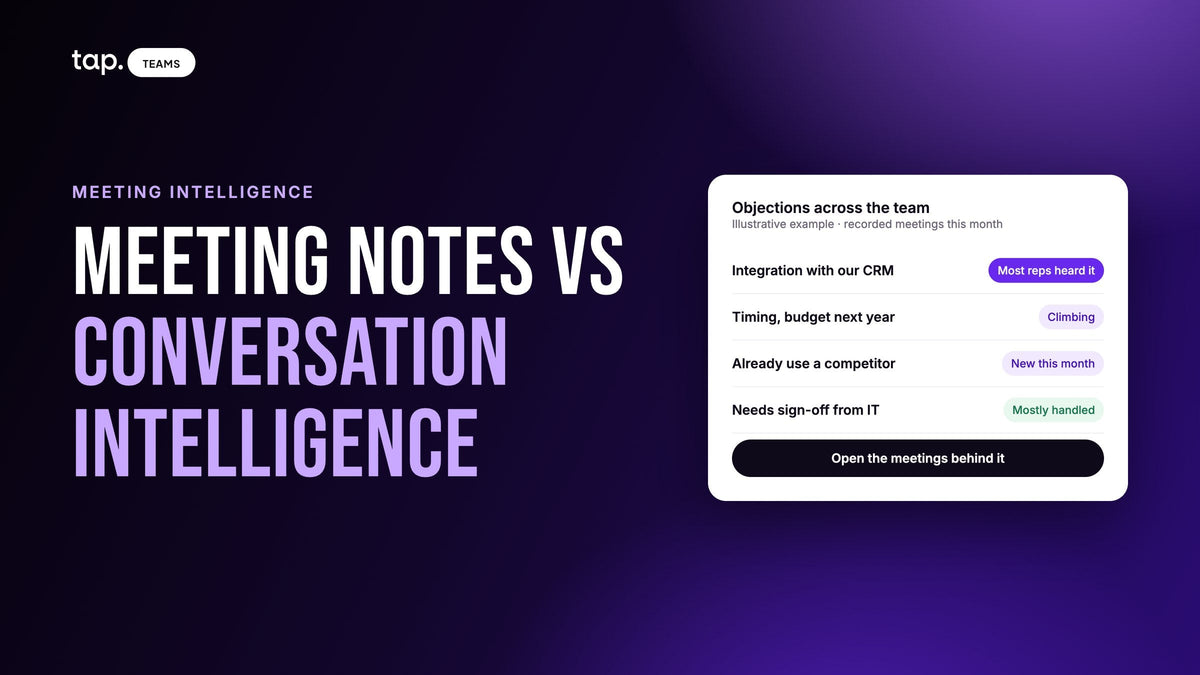
Conversation intelligence is software that analyzes recorded sales conversations, both one at a time and in aggregate. The per-meeting part looks a lot like rich notes: a summary, key topics, buying signals, objections, how much the rep talked compared with the buyer, and how the tone moved. The part notes can't do is the roll-up across the team:
- Which topics came up most this month, and which ones are climbing.
- Which objections keep recurring, across which reps, and whether they're getting answered.
- Whether sentiment on an account is drifting colder over several meetings.
- Which individual conversations are worth a manager's time in a coaching session.
- Which commitments made in meetings actually got done.
That roll-up is what makes it intelligence. A single meeting where a buyer raised an integration concern is a note. The same concern raised across several reps in one quarter is a pattern, and it usually deserves a written answer for the whole team. Our guide to tracking sales objections goes through that process step by step.

Meeting notes vs conversation intelligence, side by side
| Meeting notes (manual or AI) | Conversation intelligence | |
|---|---|---|
| Question it answers | What happened in this meeting? | What keeps happening across our meetings? |
| Unit | One conversation | Many conversations, by rep, account, team or period |
| Main reader | The rep, and whoever takes over the account | Sales managers, enablement, sometimes product and marketing |
| Typical output | Summary, action items, the buyer's own words | Ranked topics and objections, sentiment trends, coaching signals, follow-through |
| Useful from | The first meeting | Once enough meetings are recorded for a pattern to mean anything |
| What it needs from reps | Write it, or record it | Record consistently, and tag each meeting with its type |
| Typical failure | Notes nobody rereads, stuck in an app away from the CRM | Dashboards built on too few recordings, or used as a leaderboard |
The row people skip is "useful from". Notes pay off on day one. Conversation intelligence pays off only after a team has recorded enough conversations, and a manager has made a habit of reading the views. A team that buys it and records a handful of meetings a month has bought a note taker with dashboards nobody can use yet.
Where AI note takers stop and conversation intelligence starts
The middle is genuinely fuzzy. A good AI note taker for sales already flags objections and buying signals in each meeting, and that per-meeting analysis is useful to the rep writing the follow-up. I'd still call it notes, because nobody is reading across meetings yet.
Three questions sort a tool, whatever it calls itself:
- Can a manager see the same objection counted across every rep's meetings, without opening each one?
- Does it judge talk time against the kind of meeting it was, so a demo and a discovery meeting aren't held to one standard? (Our sales conversation metrics guide explains why that matters.)
- Can you ask a question across past meetings and get an answer that points back to the moment it came from?
If the answers are no, you have notes, however clever the summaries are. That may be all you need. If they're yes, and the tool records from a phone in the room as well as on calls, you're looking at meeting intelligence that works for a field team.
When meeting notes are enough
Plenty of sellers don't need conversation intelligence. Notes are usually enough when:
- You sell alone, or the team is small enough that the manager hears about every important meeting anyway.
- You hold a few long-cycle meetings a month with the same handful of accounts, where the relationship carries the deal.
- Nobody has time set aside to review conversations across the team. Analysis that no one reads is just a cost.
- The job of the notes is handover: making sure whoever touches the account next knows what was said and promised.
In that situation, put the effort into note quality: notes on the right contact, commitments turned into follow-ups, and a line of your own for what the recording couldn't hear.
When you need conversation intelligence
The case changes once there are enough reps and conversations that nobody can hold the picture in their head. Some signs you're there:
- A manager is responsible for reps they rarely see sell, spread across territories or events.
- The same objection seems to come up everywhere, but nobody can say how often or who handles it well.
- New reps are ramping and you'd like them to hear how your best people run discovery.
- Follow-ups after busy weeks slip, and you can't tell whether it's a few people or everyone.
The coaching use is the one that justifies most of the cost. A manager can't ride along on every meeting, but can open the one conversation a coaching signal points to and play the minute that matters with the rep. Our guide to field sales coaching covers how to run that session.

Can sales teams search recorded conversations?
Often, yes, and search is where notes and intelligence meet. Most tools let you search within a meeting's transcript. Searching across meetings is less common, and it comes in two kinds.
Keyword search finds every transcript where a word appears, such as a competitor's name or a product line. It's fast and literal, so it misses the buyer who described the same problem in other words.
Question answering lets you ask something like "what has this account said about delivery times?" and get a written answer drawn from several meetings. That's more useful, as long as the answer cites the moments it came from so you can play them back. An answer about a commitment or a price that you can't trace to the recording is a paraphrase you have to take on trust.
Check who can search whose meetings, since what was said about a deal is sensitive. And remember search only finds what was recorded: a team that records a fraction of its meetings has a fraction of a memory.
Trade show floor conversations: notes, intelligence, or both?
On the stand, the AI note taker does the work. Say a rep has a few dozen conversations over three days, most of them short. The ones worth recording are the real discussions: a buyer with a specific problem, a question about integration, someone who names their manager. Record those on a phone placed between you, with the buyer's agreement, and let the note taker turn each one into a summary and a list of what you promised. The thirty-second card swaps don't need a recording. Capture the contact properly and type one line.
Noise is the catch. Step to a quieter corner of the stand for the conversations that matter, set the conversation language before you start, and check names and numbers in the summary before you use them. And ask before you record, every time; consent rules differ by country, and this isn't legal advice.
After the show, conversation intelligence takes over. With every booth staffer's recordings in one place, a manager can see which topics came up most, which objections every rep heard, and which accounts more than one person spoke to. That's the briefing for the next event, and individual notes can't give it to you. Compare it with the last event, not with last month.
So would a team at a trade show benefit? If the team is two people having a handful of serious conversations, AI notes give you most of the value. If several reps are working the floor and someone will read across their conversations afterward, you'll get the most out of conversation intelligence on exactly those weeks.
How Tap handles this
Tap covers both ends. Reps record in-person meetings in the Tap mobile app against the lead they're talking to, or upload a recording they already have, and set the conversation language and meeting type. Each recorded meeting gets a transcript with speakers separated, a summary, key topics, buying signals, objections you can mark as handled, speaking time against a target for the meeting type, and sentiment. Action items become follow-ups, and the summary and action items sync to the lead's CRM record as a task. Written notes and short voice notes sit on the same lead.
Ask AI answers questions about a meeting and cites the timestamped moments it drew from, so you can play them back. On Enterprise plans it can switch to All meetings and search every meeting you have permission to see.
For managers, Team Insights rolls recorded meetings up across the team: topics and objections, top accounts, coaching signals, sentiment trends, at-risk accounts and action completion. Competitors named in notes and meetings are counted too, and a Note themes view groups what reps write by meaning. Insights are built from recorded meetings, so a team that rarely records will see little. Recordings and transcripts are visible to the rep who captured them and to admins.
There's more on the meeting intelligence page, or you can book a demo and we'll walk through it with your own meetings.
Related reading
- Meeting intelligence for field sales: the complete guide
- AI notes for in-person sales meetings (no bot required)
- How to track sales objections when your team sells in person
- Field sales coaching
FAQ
What's the difference between meeting notes and conversation intelligence?
Meeting notes are a record of one conversation: what was discussed, what each side agreed, what happens next. Conversation intelligence analyzes many recorded conversations together, surfacing recurring topics and objections, sentiment trends, coaching moments and follow-through across a team. Notes help one person remember a meeting; conversation intelligence helps a manager see patterns.
Is an AI note taker the same as conversation intelligence?
No. An AI note taker records a meeting, transcribes it and writes a summary and action items. Some add per-meeting signals like objections. Conversation intelligence goes further by reading across a team's meetings, so a manager can see which objections recur, how talk time compares with the meeting type, and which conversations are worth reviewing.
Can sales teams search recorded conversations?
Usually within a single transcript, and with some tools across all of them. Cross-meeting search is either keyword search, which finds exact words, or question answering, which writes an answer from several meetings. Prefer answers that cite the moment in the recording, and check who is allowed to search whose meetings.
Would an AI note taker or conversation intelligence help on a trade show floor?
An AI note taker helps during the show: record the substantive conversations on a phone, with consent, and get a summary and commitments for each. Conversation intelligence helps after it, by showing which topics and objections came up across every rep on the stand. Small teams with few serious conversations get most of the value from notes alone.

Leave a comment
This site is protected by hCaptcha and the hCaptcha Privacy Policy and Terms of Service apply.