
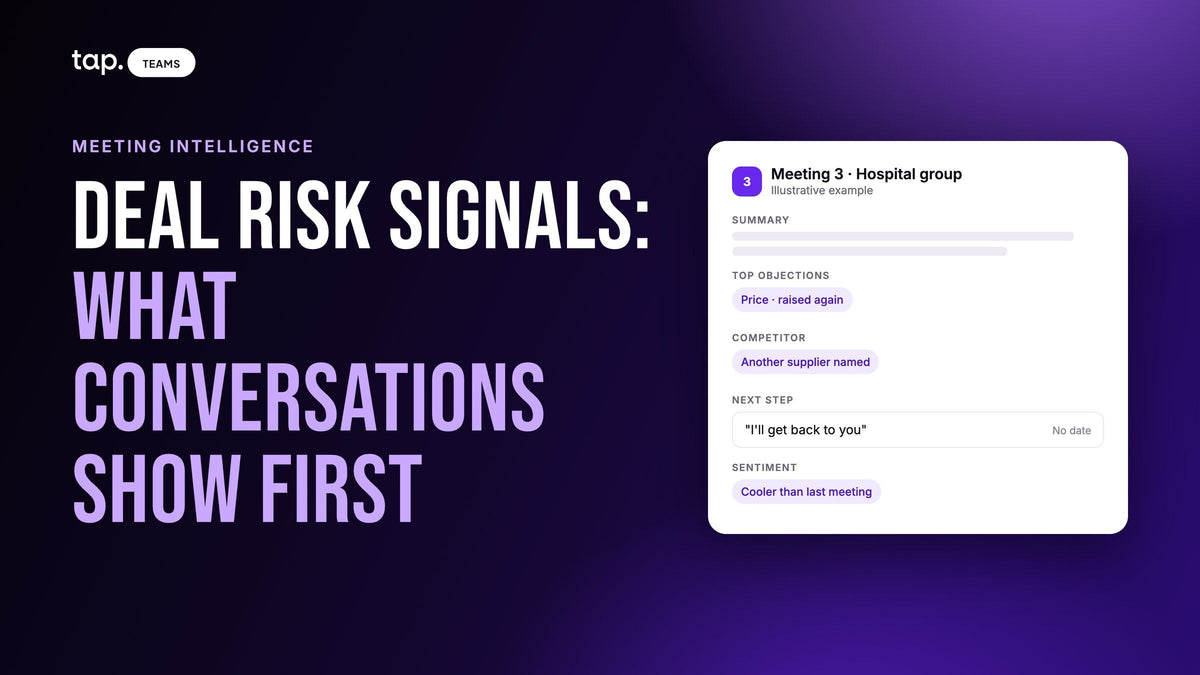
Deal risk signals are things buyers say, or stop saying, that suggest a deal is slipping before the CRM shows it. The common ones: no dated next step, only one person on the buyer's side, objections that come back unanswered, a competitor named, a timeline or budget gone vague, and a buyer asking fewer questions each meeting.
Most writing on this assumes the deal lives on video calls and email, where software can watch every touch. Plenty of deals don't. A rep selling to hospitals, contractors or distributors meets the buyer in their office, at a stand, or over coffee, and the manager hears about it afterwards in a sentence or two. This article is about reading risk in those conversations: which signals matter, how to read them across several meetings, and what to do once you see them. For the wider picture of recording and analyzing field meetings, start with our meeting intelligence guide for field sales.
Why deal risk hides in field sales
A deal rarely slips in one moment. It slips across several meetings, each of which sounded fine to the rep at the time. The CRM sees almost none of it. The stage says Proposal, the close date is whatever the rep typed in a month ago, and the amount hasn't changed. Those fields describe what the rep hoped would happen, and nobody updates a hope.
Field selling makes this worse in a few specific ways. There's no email thread from the meeting itself, no calendar invite showing who attended, and often no recording. The rep's memory is the only record, and memory is optimistic. "Good meeting, they're keen" can cover a buyer who was polite, asked nothing, and said they'd need to check with someone the rep has never met.
The manager, meanwhile, is reviewing a pipeline of deals they've never heard a word of. By the time the forecast call asks "is this still closing this quarter?", the honest answer was available three meetings ago.
Deal risk signals to listen for
None of these means a deal is lost. Each is a reason to ask a question. The ones that matter most are the ones that show up together, or get worse from one meeting to the next.
No next step, or one without a date
Often the first sign, and the easiest to check. A meeting that ends with "send me something and we'll be in touch" has no next step. A real one has a date, a person on each side, and a reason the buyer wants it to happen. Listen for who owns it, too. If every next step is something the rep will do (send pricing, send a case, call back), the buyer hasn't committed to anything.
Only one person on the buyer's side
Single-threaded deals die when that one person changes jobs, goes on leave, or loses the internal argument. In person, this shows up as the same face in every meeting and phrases like "I'll take it to my director" or "let me run it past finance." Ask who else was in the room. If the answer has been the same name for months, the deal depends on someone you can't see.
Objections that come back
One objection in a meeting is normal. The same objection raised again in the next meeting means the first answer didn't land, and the buyer is now telling you it matters. Price raised twice, or a question about a missing feature that keeps returning, is worth more attention than three new objections. The method for logging them is in our guide to tracking sales objections; for deal risk, the useful question is simply which ones are still open.
A competitor in the conversation
Buyers rarely announce that they're evaluating someone else. They say "we're looking at a few options," "your rival came in last week," or ask a question that only makes sense if they've seen another product. A competitor mentioned once may just be a bargaining chip. A competitor mentioned alongside a price objection, by a buyer who's gone quieter, is a different story.
Timeline and budget going vague
Early meetings often have a reason to buy by a certain time: a new site opening, a contract ending, a budget cycle. When that reason stops coming up, or the buyer starts saying "sometime next year" and "once things settle down," the deal has lost its deadline. The same goes for budget. "It's in the plan" turning into "we'll need to find the money" is a change worth hearing in the buyer's own words.
The buyer asking fewer questions
Engaged buyers ask how things work, what onboarding looks like, who else uses it, what happens if something breaks. Those questions are buying signals. When they dry up and the buyer just listens and nods, interest has usually gone somewhere else. This one is easy to miss in a single meeting and obvious across three.
Tone cooling from one meeting to the next
Shorter meetings, a buyer who arrives late and leaves early, answers that get flatter. A rep feels this in the room but rarely writes it down, and it's the first thing to disappear from memory.
Longer gaps, and promises not kept
Watch the space between meetings. If meetings used to be a couple of weeks apart and the next one is "after the holidays," something has changed. Commitments matter in both directions. A buyer who said they'd send their current contract and didn't is cooling. A rep who promised a revised quote and didn't send it may be the reason.
The rep doing all the talking
A rep who pitches through a meeting learns nothing about the deal. That's why talk ratio belongs on the list, but as a cause rather than a symptom: a meeting where the rep talked most of the time is a meeting where the other signals had less chance to surface.

What call metrics predict deal risk beyond talk ratio?
Talk ratio tells you how a meeting was run. It says very little about whether the buyer is moving. A rep can hit the right share of airtime in a meeting where the buyer agreed to nothing. (Our article on sales conversation metrics covers talk ratio and question rate in detail.)
The measures that point at risk describe the buyer's side of the conversation, and they work best tracked per deal across meetings:
- Whether a next step was agreed, and whether it had a date.
- How many different people from the buyer's side have taken part so far.
- Objections still open, and whether any came back a second time.
- Competitors named, and in which meetings.
- How many questions the buyer asked, compared with earlier meetings in the same deal.
- Commitments made in meetings, on both sides, and how many were done.
- Time since the last meeting, against how often you were meeting before.
I won't give thresholds for any of these. Nobody has published one that holds across industries, and a figure borrowed from another team's phone calls says little about your reps in a customer's office. Take a handful of deals you won and a handful you lost this year, and look at what the meetings in each had in common. If the lost ones mostly had no dated next step after the second meeting, that's your threshold.
Here's how the signals translate into what a manager actually asks:
| Signal | How it sounds in the room | Question for the deal review |
|---|---|---|
| No dated next step | "Send it over and we'll be in touch" | What did they agree to do, and by when? |
| Single-threaded | "I'll take it to my director" | Who else on their side have you met? Who signs? |
| Repeated objection | "We still think it's expensive" | What did you say last time, and what did they say back? |
| Competitor named | "We're looking at a few options" | Which one, and what did they like about them? |
| Timeline drifting | "Sometime next year" | What was the original reason to buy by a date? Is it still there? |
| Fewer buyer questions | Nods, "sounds good" | What was the last thing they asked you? |
| Commitments slipping | "I haven't had a chance to send that yet" | What's still open on our side, and on theirs? |
Reading signals across several meetings
One meeting with a vague next step is a bad afternoon. The same pattern across three meetings is a deal in trouble, so compare each meeting with the last one in the same deal.
Say a rep is selling to a private hospital group. In the first meeting, the procurement lead brings a clinical lead along, they ask about training and rollout, and they agree to a site visit on a set date. In the second, only the procurement lead turns up. Price comes up, along with a mention that another supplier has been in. The meeting ends with "I'll get back to you." The third meeting happens five weeks later instead of two. It's short, the buyer asks nothing, and the timeline has moved to "after budget season."
Ask the rep after each meeting and you'll hear "went well," "a bit of price pushback," and "they're still interested." All three are true. Put the three meetings side by side and the deal has lost its second contact, gained a competitor, kept an open objection, lost its date and gone quiet. The CRM, meanwhile, still shows the same stage and the same close date it did after the first meeting.

Signals that mislead
Risk signals produce false alarms, and treating every one as an emergency teaches reps to stop reporting them. A few to read carefully:
Silence during procurement or legal review is often just silence. Buyers go quiet when the paperwork is with someone else. Check whether the next step was agreed before the quiet started.
A competitor named once can be the buyer testing you on price. It matters when it comes with other signals, or when the buyer starts using the competitor's language.
And the biggest one: no signals at all. If the rep didn't record the meeting or write anything down, a deal can look clean simply because nobody captured anything. Before you trust a quiet deal, check that there's a record of what was said.
What a manager does with a risky deal
Start with questions, before opinions. Ask the rep to walk through the last meeting, and listen for the gaps: who was there, what was agreed, what's still open. Reps usually know a deal is wobbling. They need a reason to say so out loud without it counting against them.
If you can, listen to the minute that matters. A recording of the moment the buyer raised price for the second time tells you more than any summary, and it lets the rep hear how their answer landed. Our guide to field sales coaching covers how to run that conversation when you weren't in the room.
Then agree one move for the next meeting. Most rescues are one of these:
- Ask to meet the person the buyer keeps mentioning, with the buyer's help: "Would it be useful if I walked your director through it with you?"
- Name the open objection directly instead of hoping it went away: "Last time you said the price was hard to justify. Where are you on that now?"
- Rebuild the timeline around the buyer's own reason: "You mentioned the new wing opens in spring. What needs to be in place before then?"
- Close the gaps on your side. Send what was promised before asking for anything.
And sometimes the right move is to change the forecast. A deal with no date, one contact and an open price objection may still close, just not this quarter. Saying so early is more useful to the business than a surprise at the end of it.
How Tap handles this
In Tap, reps record in-person meetings on their phone against the lead they're meeting, or upload a recording they already have. Transcription separates speakers, and the analysis gives a summary, key topics, buying signals, top objections you can mark as handled, speaking time against a target, and sentiment showing how the tone moved. Competitors named in the conversation are picked out, and action items become follow-ups that sync to the CRM as tasks. More on what each meeting produces is on the meeting intelligence page.
Ask AI answers your own questions about a meeting, such as which objections were left unhandled or what was committed to, and cites the moment in the recording so you can play it. On enterprise plans it can search across all the meetings you're allowed to see, so you can ask what one account has said over several meetings, or where a competitor came up.
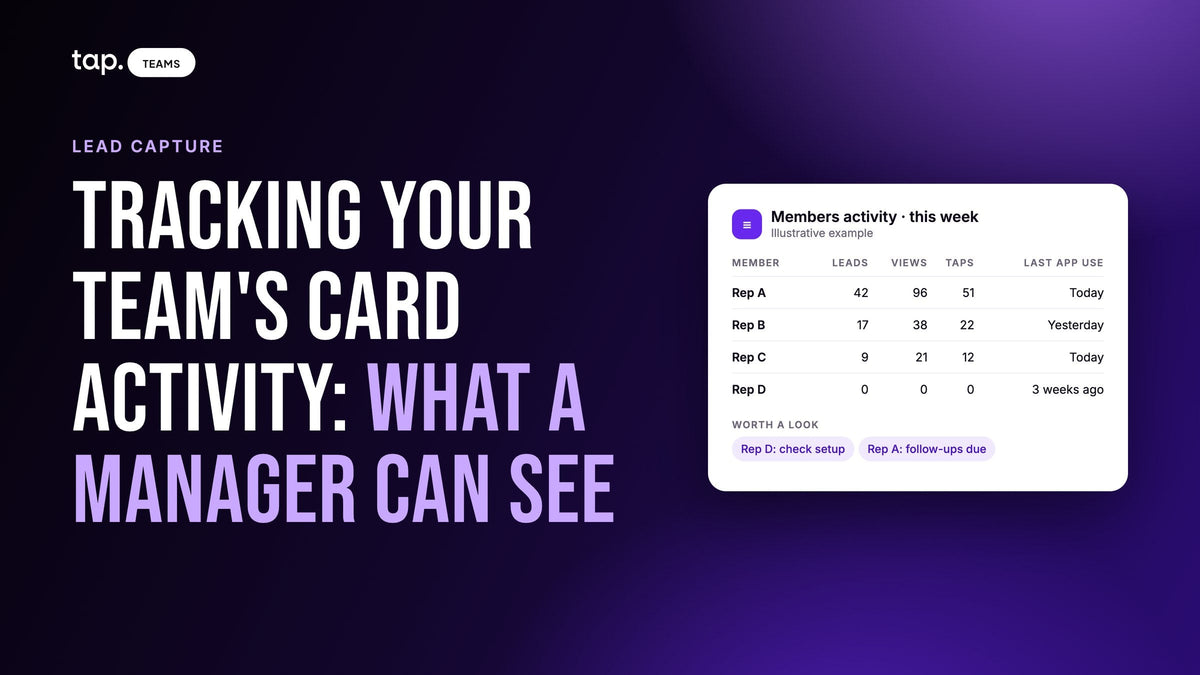
For managers, Team Insights includes sentiment trends and a list of at-risk accounts, meaning accounts whose conversations have turned negative or gone quiet. It also ranks topics and objections across the team, and shows action completion: how many of the commitments made in meetings were marked done, per person. Competitors lists each rival named in notes and recorded meetings, with the change against the previous period. Notes are read too: a flagged note shows whether a promise went unanswered, whether several notes on one account say the deal is in trouble, or whether a competitor is being named.
All of this is built from what the team records and writes down. A rep who never records will show little, and a quiet board can mean a quiet market or an unrecorded one. Some of the team-level views are on the Enterprise plan.
You can book a demo and we'll walk through it with a few of your own deals, or see how it works on the meeting intelligence page.
FAQ
What are deal risk signals?
Deal risk signals are signs in sales conversations or deal activity that a deal may slip or be lost: no dated next step, a single contact on the buyer's side, objections that stay open, a competitor named, a vague timeline or budget, falling buyer engagement, and longer gaps between meetings. Each is a prompt to ask a question, and they matter most in combination.
What call metrics predict deal risk beyond talk ratio?
Look at the buyer's side of the conversation, tracked per deal across meetings: whether a dated next step was agreed, how many buyer-side people have taken part, open and repeated objections, competitors named, how many questions the buyer asked compared with earlier meetings, commitments kept on both sides, and time since the last meeting. Set thresholds from your own won and lost deals.
How do you know if a deal is slipping?
Compare the latest meeting with the earlier ones in the same deal. A deal is usually slipping when several things change at once: fewer people from the buyer's side, a next step without a date, an objection raised again, a competitor appearing, and a buyer asking fewer questions. CRM stage and close date tend to be the last things to change.
Can AI detect deal risk from in-person sales meetings?
Yes, if the meeting is recorded. A phone between the rep and the buyer, with their agreement, gives a transcript that software can analyze for objections, competitors, sentiment and commitments. It only sees what was recorded, and noisy rooms reduce accuracy, so treat its flags as prompts to listen to the moment rather than verdicts on the deal.

Leave a comment
This site is protected by hCaptcha and the hCaptcha Privacy Policy and Terms of Service apply.