
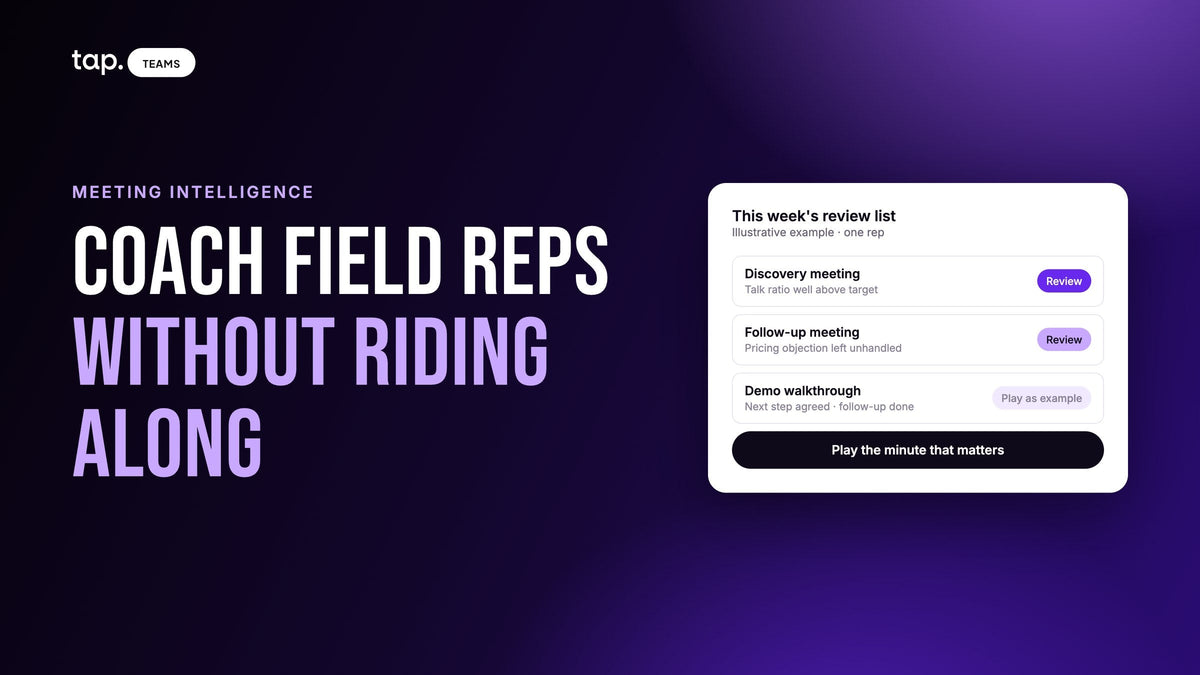
To coach field reps when you can't sit in on their meetings, coach from what the meeting left behind: the recording, the rep's notes, the objections it raised and whether the follow-ups got done. Pick a few moments each week, listen to them with the rep, work on one behavior at a time, and check the next week whether it changed.
Ride-alongs still have their place, but they can't be the whole system. A manager with reps spread across a region sees a sliver of their meetings in person, and the rep with the boss in the passenger seat doesn't sell the way they do alone. This guide covers what to coach from instead, a weekly rhythm that fits a field manager's calendar, how to tell whether training is showing up in real conversations, what to measure and what to leave alone, and how to introduce recording to a team that has never been recorded.
Why coaching outside sales reps is harder
An inside sales manager can listen to a call live, or pull up yesterday's recording between meetings. A field manager's reps are in a customer's office, a clinic, a site cabin or a trade show stand, often in a different city. What reaches the manager is the rep's account of the meeting, written up later, from memory, by the person with the most reason to remember it kindly.
That leaves field coaching with three habits that don't work well. The first is coaching on outcomes only: the deal closed or it didn't, so the conversation is about the pipeline and never about the meeting. The second is coaching on the rep's summary, which tells you what they noticed and nothing about what they missed. The third is saving everything for the ride-along, which happens rarely enough that each one turns into a performance review.
The fix is to get some of the actual conversation back. Not all of it, and not every meeting. Enough that when you sit down with a rep, you're both looking at something they said rather than at a number.
What to coach from when you weren't in the room
Four things can stand in for being there. Each one shows a different part of the meeting, and none of them is enough alone.
Recorded meetings
A recording is the closest thing to sitting in. With a transcript, a summary and the speakers separated, you can find the two minutes that matter without listening to forty. Look for the moment the buyer raised a concern, the moment the rep asked about budget or timing, or the moment the conversation turned. Our guide to meeting intelligence for field sales covers how recording works in person, and how to get audio worth analyzing in a noisy room.
Analysis can point you at the right meeting. A discovery meeting where the rep talked far more than they listened is worth opening; the talk-to-listen ratio guide explains how to read that number without turning it into a grade. So is a meeting where the buyer gave a clear buying signal and the rep didn't follow it up.
The rep's own notes
Notes show what the rep thought mattered. Read one next to the recording of the same meeting and the gap between them is often the coaching point: the rep wrote "good meeting, send proposal" and the buyer spent five minutes on an integration worry the note never mentions. For what good notes from a face-to-face meeting should contain, see our piece on AI notes for in-person sales meetings.
Objections and topics across the team
One rep fumbling an objection is a coaching conversation. Half the team fumbling the same one is an enablement problem, and no amount of one-to-one coaching will fix it. Looking at objections across all recorded meetings tells you which is which before you spend an hour on the wrong one.
Follow-through
A great meeting followed by nothing is a lost meeting. The commitments made in the room ("I'll send the pricing", "I'll bring our engineer next time") are easy to track once they're written down as follow-ups, and whether they get done is as coachable as anything said in the meeting itself.

A weekly coaching rhythm for field managers
Coaching that happens when there's time doesn't happen. A short weekly routine, the same every week, beats an occasional long session. Here's one that works for a manager with a handful of reps and no time to listen to everything.
Early in the week: pick what to review
Start with the team view, not with individual reps. Which objections came up most last week? Is anything new? Which accounts have gone quiet? Then look per rep for the few meetings worth opening: a coaching signal on a discovery meeting, an objection left unhandled, a promising meeting with no follow-up logged. You're building a short list, two or three moments per rep at most. You can't listen to everything, and you shouldn't try.
Before the one-to-one: find the minute that matters
Open each meeting on the list and find the stretch worth discussing. Usually it's under two minutes. If the tool lets you ask questions about a recording, something like "Which objections did the rep leave unhandled?" gets you to the moment faster than scrubbing through the audio.
In the one-to-one: let the rep go first
Play the clip together. Then ask the rep what they heard and what they'd do differently, and wait. Most reps spot the problem themselves once they hear it, and a point they found sticks far better than one they were told. Add your view after theirs. Agree one thing to change, only one, and write it down in a sentence the rep would recognize: "In discovery, ask about the current supplier before showing anything."
Leave room for what went well, too. Play a moment where the rep handled something properly and say so. Reps who only ever hear their recordings in a critique start recording less.
The next week: check it changed
Open one or two of the rep's next meetings and listen for the thing you agreed. Did they ask about the current supplier? If yes, tell them, and move on to the next behavior. If not, find out why before raising it again. Sometimes the meeting type didn't allow it; sometimes the habit just needs another week.

Reinforcing sales training in live conversations
A common complaint from enablement teams goes like this: we run a training program every quarter, reps pass the assessment, and nobody knows whether any of it shows up in front of a customer. Recording closes that loop, as long as you decide in advance what you're listening for.
Training content is usually too broad to check. "Run better discovery" can't be heard in a recording. "Ask who else is involved in the decision before the end of the first meeting" can. So before the next training goes out, turn each module into one or two behaviors you'd be able to hear in a real conversation.
Then look for them. In the weeks after the training, managers listen for those specific behaviors in their weekly reviews instead of a general impression of the meeting. Across the team, watch the objection the training was meant to handle. If reps now have a good answer to it, it should be marked as handled more often, or it should stop turning into a stalled deal. If the objection keeps climbing a period later, the answer isn't landing, and the training needs another pass.
The topics view helps in the other direction. The subjects buyers raise unprompted are the best input for the next training. If a question keeps coming up in meetings and the training never mentions it, that's the module to write next.
What to measure, and what to leave alone
Field teams have plenty of numbers. Most of them are better for spotting problems than for judging people. Here's how the common ones hold up in coaching.
| Number | Use it for | Don't use it for |
|---|---|---|
| Meetings recorded and leads captured | Spotting a rep who stopped using the tools, or can't (usually a setup or training problem) | Ranking reps. Territory and events decide volume far more than effort does |
| Follow-up completion | Seeing who closes loops, read next to how much each rep captured | Judging a rep alone. High volume with low completion usually means overloaded |
| Talk ratio against the target for the meeting type | Choosing which recording to open | A leaderboard. Reps learn to go quiet, which isn't the same as listening |
| Recurring objections | Deciding between one-to-one coaching and a team-wide answer | Blaming the rep who hears it most. They may just have more conversations |
| Notes written per rep | Seeing who documents their meetings and who doesn't | Measuring quality. A long note can still miss the point |
The pattern across all of them: a number tells you where to look, and the conversation tells you what happened. Coach from the number alone and you end up arguing about the number.
Combinations say more than any single figure. A rep with lots of meetings and few completed follow-ups needs their load cut or redistributed; more coaching won't create hours. A rep with fewer meetings and every follow-up done may be your most thorough person and under-used. A rep strong on both is the one to learn from. Ask them to walk the team through a recording of a meeting that went well. That's often worth more than the next training session.
And if everyone is low on follow-through, it's a process problem. Check that reps are marking follow-ups done in one agreed place, and that they get protected time after an event to do them, before you coach anyone.
Coaching new reps, experienced reps and your best people
The weekly rhythm is the same for everyone. What you review changes.
New reps need more of your review time in their first months, and the focus is on basics: opening the meeting, asking before pitching, agreeing a next step before leaving. Review more of their meetings, and use recordings from your best reps as the example of what good sounds like in your market.
Experienced reps usually don't need their basics checked. Coach them on the meetings that stretch them: a negotiation, a new kind of buyer, an account that's gone quiet. Let them pick the recording sometimes. People who choose what gets reviewed treat the session as theirs.
Your best people are the most under-used part of most coaching programs. Their recordings are the training material. A clip of a strong rep handling the objection everyone else struggles with, played at a team meeting, does more than a slide with the "approved answer" on it.
Rolling out recording to a field team
A conversation intelligence tool only helps if reps record, and reps record when they trust what the recordings are for. Treat the rollout as a change in how the team works, with the software as the smaller part.
- Say plainly what recordings are for before anyone records. If they're for coaching, say they won't be used to rank people, and keep that promise. The first time a recording appears in a performance review without warning, recording stops.
- Start with reps who want it. Every team has a few who like feedback, or who hate writing notes. Their early recordings become the examples you play to everyone else.
- Agree what gets recorded. Discovery meetings, demos, negotiations and real follow-up conversations, yes. A quick card swap at a stand, no. That keeps the review list useful and the transcription budget sane.
- Write the consent line for reps, so nobody improvises it in front of a customer, and make sure it's asked at the start of every conversation. The meeting intelligence guide covers consent and regulated industries in more detail; bring compliance in early if you sell in pharma, banking or anything similar.
- Tell reps who can see their recordings, and stick to it.
- Use the recordings visibly and early. In the first weeks, play a good moment from someone's meeting at a team meeting, with their agreement. Reps keep recording when they see recordings used for something that helps them.
- Wire it into the routines you already have. If the weekly one-to-one and the pipeline review don't touch the recordings, managers stop opening them, and reps notice.
Expect the first few weeks to be uneven. Some reps will record everything, some nothing. A rep who records nothing is more often stuck on setup than resisting, so check that before anything else.
Where ride-alongs still matter
Recordings don't replace being there. A lot of a face-to-face meeting isn't in the audio: the buyer checking their phone when price came up, the rep standing while everyone else sat, the colleague who walked in and changed the room. Some skills, like reading a room or working a busy stand, are easier to coach when you saw them yourself.
What changes is how you use the ride-along. When you already know from the recordings what a rep is working on, a ride-along becomes a focused session on that one thing, and you can spend the drive between meetings on it. It's also the right moment for the conversations recordings can't have: how the territory is going, what's getting in the way, how the rep is doing.
How Tap handles this
In Tap, reps record a meeting in person against the lead they're talking to, or upload a recording they already have, and set the language and meeting type. Each recorded meeting gets a summary, key topics that jump to the moment they came up, buying signals, objections you can mark as handled, speaking time against the target for its meeting type, sentiment, and action items that become follow-ups. Ask AI on a meeting answers a plain question, like "Which objections did I leave unhandled?", and cites the moments it drew from so you can play them back. Those threads are private to the person who asked.
For managers, Team Insights rolls recorded meetings up across the team. Topics and objections show what buyers are raising and what keeps getting in the way, coaching signals point to conversations worth reviewing with the rep who had them, and top accounts show companies coming up across several reps. Member activity lists leads and notes per person, and action completion shows, per member, how many of the commitments made in meetings were marked done. Recordings and transcripts are visible to the rep who captured them and to admins.
Some of the team views, like field coverage, are on the Enterprise plan. There's an overview of what managers see on the Team Insights page, or you can book a demo and we'll walk through it with your own coaching routine.
Related reading
- How to track sales objections when your team sells in person
- Talk-to-listen ratio in sales: how much should a salesperson talk?
FAQ
How do you coach field sales reps when you can't observe their meetings?
Coach from recordings of the meetings, the rep's notes, the objections coming up across the team and whether follow-ups got done. Each week, pick a few moments per rep, listen to them together in the one-to-one, agree one change, and check the rep's next meetings for it.
How often should you coach outside sales reps?
Weekly works for most field teams: a short one-to-one built around one or two recorded moments, plus ride-alongs less often for the skills audio can't show. A fixed weekly slot matters more than its length. Coaching saved up for a quarterly review turns into a performance conversation.
How do you know if reps are applying sales training on live calls?
Turn each training module into one or two behaviors you could hear in a recording, then listen for them in the weeks after. Watch the objection the training targeted across the team's recorded meetings. If it's still climbing a period later, the answer isn't landing in real conversations.
How do you roll out a conversation intelligence tool across a sales team?
Tell reps what recordings are for and who can see them before anyone records. Start with the reps who want it, agree which meetings get recorded, write the consent line for them, and use recordings visibly in one-to-ones and team meetings from the first weeks. Never use them to rank people.
Can call recordings replace ride-alongs for field reps?
Not entirely. Recordings let you coach far more meetings than you could ever attend, but body language, the room and how a rep works a stand aren't in the audio. Use recordings for the weekly rhythm and keep fewer, more focused ride-alongs for what you need to see.

Leave a comment
This site is protected by hCaptcha and the hCaptcha Privacy Policy and Terms of Service apply.