
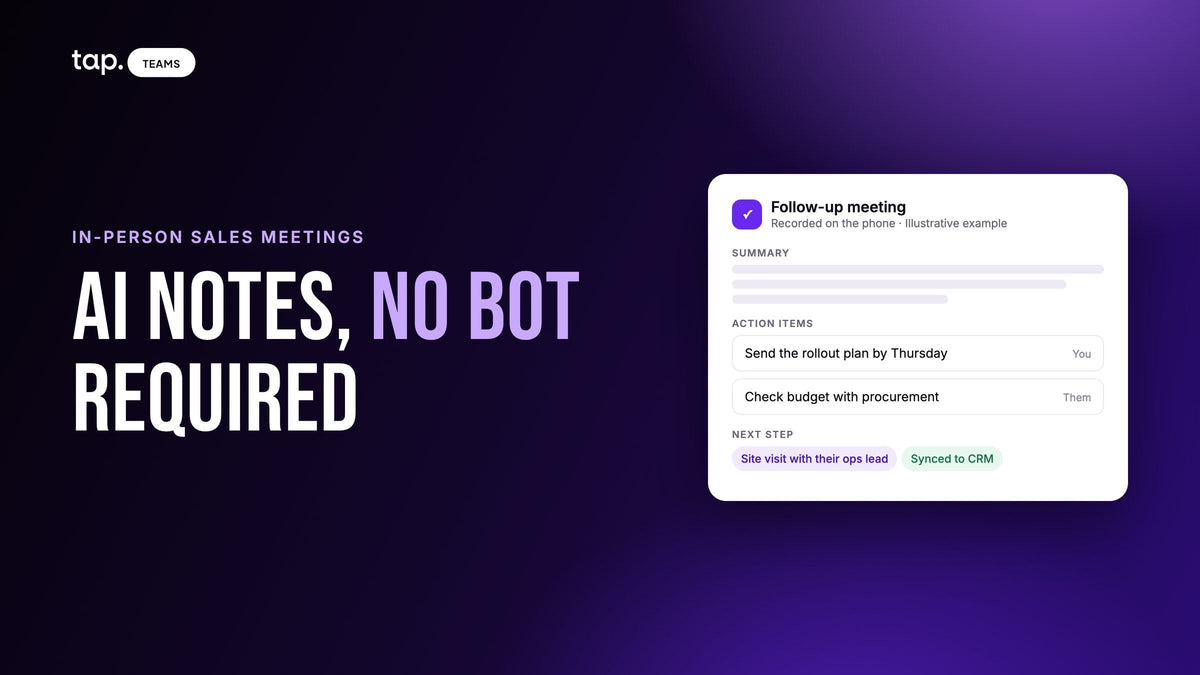
An AI note taker for in-person meetings records the conversation on a phone or small recorder in the room, transcribes it with the speakers separated, and writes a summary and action items. No bot joins, because there's no call to join. For a sales meeting, the notes also need to land on the right contact and in your CRM.
Most guides on this are written for a conference room. Sales conversations in person are messier: across a customer's desk, at a trade show stand, in a hospital corridor, often over in ten minutes. This article is about the note-taking job itself in those meetings, what you get, the routine before, during and after, and where it goes wrong. For the wider picture of analyzing field conversations, see our guide to meeting intelligence for field sales.
Why the bot can't come to this meeting
A meeting bot joins a video call through the link in the invite and listens to the call audio, where every person has their own microphone. A face-to-face meeting has no link and no call audio, just one microphone in the room picking up everyone at once. So in person, the note taker is an app on the phone in your hand, a laptop on the table, or a dedicated recorder. For sales, the phone usually wins. Reps already carry one, it goes to the stand and the site visit, and the recording can be tied to the person you just met while you're still standing there. A separate recorder's files arrive as a list of timestamps that someone has to match to people later.
AI notes vs handwritten notes
Handwritten notes aren't going away, and they shouldn't. But they do a different job from AI notes, and it helps to know which one you're relying on for what.
| Handwritten notes | AI notes from a recording | |
|---|---|---|
| What gets captured | What the rep thought mattered at the time | Everything that was said, word for word |
| Attention during the meeting | Split between the buyer and the notepad | On the buyer |
| The buyer's exact words | Paraphrased, if written at all | In the transcript |
| Commitments | The ones the rep remembered to write down | Pulled out as action items, both sides |
| Things that aren't words | A glance at the watch, who went quiet, your gut read | Missing |
| Ten conversations later | Hard to read, easy to mix up | A summary per conversation |
The last-but-one row matters most. A recording hears words. It doesn't see the buyer lean in when you mention delivery times, or notice that the person nodding along isn't the one who signs. That's why the best routine uses both: the recording for the record, and a line or two of your own for what the microphone missed.
What good AI notes from a sales meeting contain
A general note taker writes a tidy summary of what was discussed. A sales meeting needs more, because the notes have a job afterward: drive the follow-up, and tell whoever touches the account next what happened.

- The contact they belong to. Notes sitting in a separate app under "Meeting, Tuesday afternoon" tend to stay there.
- The buyer's own words on what matters to them. "Our current supplier misses deliveries every quarter" makes a better follow-up than "discussed supply issues."
- Commitments on both sides: what you promised to send, and what they said they'd do, like checking with procurement.
- Moments that point toward a purchase, and the pushback. Our guide to buying signals in a sales conversation covers what to listen for.
- The next step, if one was agreed. If none was, the notes should make that obvious.
The routine: before, during and after an in-person meeting
The software does the transcribing. Whether the notes are any use depends on a few small habits around it.

Before
Capture the person's details first, so the recording has a contact to belong to. A recording filed against "unknown" is a chore for the evening. Set the conversation language if your tool asks for it, and have your consent line ready so you don't improvise it.
During
Ask before you press record, every conversation. Recording someone requires their knowledge and, in many places, their consent, and the rules vary by country and sometimes by state; check where your team sells, since this isn't legal advice. A reason helps: "Mind if I record this so I'm not scribbling? I'll send you a summary of what we agreed." If they say no, the phone goes away without fuss. The pillar guide has more on consent and getting clean audio in person; the short version is phone flat on the table between you, their name said early, and the whole conversation recorded from the start.
Then stop thinking about notes. Not having to write things down is most of the point. Listen, ask the next question, and let the buyer talk. If you notice yourself pitching the whole time, that's worth knowing too, and talk-to-listen ratio is how you'd measure it.
The minute after
This is the step people skip, and it's the one the recording can't do for you. Before the next conversation starts, add a line or two of your own: who seemed to be the decision maker, how warm they were, what the body language said, anything they told you once the phone was off. A spoken voice note on the walk to the next meeting works if typing is too slow.
One minute here saves you from the evening debrief where every conversation blurs into "good chat, follow up."
The same day
- Read the summary while you still remember the room. Fix names, numbers and dates the transcript got wrong.
- Check the action items against what you promised. Add anything missing.
- Write the follow-up from the buyer's own words: the delivery problem they described, not "great to meet you at the show."
- Get the notes and follow-ups onto the contact in your CRM, so whoever picks up the account next can read what was said.
- Use what you heard to decide who to call first. A buyer who asked about rollout and named their manager outranks one who took a brochure. Our lead scoring guide covers how to weigh that.
Where AI notes fail in person
Expect good transcripts, not perfect ones. The failures are predictable, and most have a simple workaround.

Noise is the big one. A trade show floor, a busy café or a factory gives the microphone a lot to fight through. Move somewhere quieter for the conversation that matters, and keep the phone close to both of you.
Mixed languages come next. Conversations that switch languages mid-sentence, common wherever people mix Arabic and English at work, are the hardest case for transcription. Setting the main language helps. Checking the summary against your memory helps more.
People talking over each other confuse speaker separation, and so does a colleague who joins halfway through. Product names and industry jargon get mangled most often, though the summary usually still gets the meaning right. Walking meetings, like a site tour, produce rougher audio however you hold the phone.
And very short exchanges barely count as meetings. Thirty seconds of "here's my card, let's talk next week" gives you a transcript nobody will read, and on most tools it uses up transcription time a real conversation could have used. Capture the contact details properly (our guide to trade show lead capture covers that) and save recordings for conversations with substance.
When a quick written note beats a recording
Sometimes the written note is the better tool, not the fallback:
- The buyer said no to recording.
- The exchange lasted under a minute and only one thing mattered.
- The conversation turned personal or confidential.
- You're somewhere recording is out of place, like a hospital ward or a customer's shop floor.
- What mattered wasn't said out loud: the buyer's reaction, or who they deferred to.
Two sentences typed within ten minutes beat a perfect recall attempt a week later. Put them on the contact, the same place the recordings go, so a rep's notes and recordings tell one story.
What to look for in a phone-based note taker
Tools built around bots are judged on calendar integration and which video platforms they join. None of that matters for a meeting across a desk. For in-person sales, check these instead:
- Recording on the phone with no call involved, plus upload for recordings made some other way.
- Each recording attached to the contact it was about at the moment you record, not matched later.
- A way to set the conversation language before processing.
- Processing in the background, so the rep can put the phone away and start the next conversation.
- Somewhere for your own written or spoken note next to the recording.
- Commitments turned into follow-ups, and notes that reach the right CRM record.
Then test it on a recording from a noisy room of your own. A demo file recorded in a quiet studio tells you very little about an exhibition hall. There's a fuller buying checklist in the meeting intelligence guide linked above, and the meeting intelligence page shows how Tap approaches it.
How Tap handles this
Tap isn't a meeting bot. A rep records the conversation in the Tap mobile app (iPhone or Android, in English or Arabic) against the lead they're talking to, or uploads a recording they already have. They pick the conversation language and the meeting type, and transcription and analysis run in the background while they move on. For something shorter than a full conversation, there's a voice note, which is transcribed and summarized.
Each recorded meeting gets a transcript with the speakers separated, a summary, key topics that jump to the moment they came up, buying signals, objections you can mark as handled, speaking time against a target for the meeting type, and sentiment. Action items become follow-ups. When analysis finishes, the summary and action items sync to the lead's CRM record as a task.
For questions the analysis didn't cover, Ask AI on the meeting takes a plain question, like "Did I commit to anything?" or "What did they say about pricing?", and cites the moments it drew from, with a timestamp and the speaker, so you can play them back. Ask in Arabic and it answers in Arabic. If nothing in the conversation answers the question, it says so. It can also draft the follow-up email, which opens in your own mail app for you to edit and send. Tap never sends it for you.
Recordings can't be edited, so a wrong word gets corrected with a written note on the lead. Recordings and transcripts are visible to the rep who captured them and to admins, and deleting a lead removes its meetings and transcripts. Transcription minutes come from one shared pool for the whole team, which is one more reason to skip recording the card swaps.
There's more on the meeting intelligence page, or you can book a demo and try it on a recording from one of your own meetings.
Related reading
- Meeting intelligence for field sales: the complete guide
- Buying signals: how to spot them in a sales conversation
- Talk-to-listen ratio: how much should a sales rep talk?
FAQ
Can AI take notes in an in-person meeting without a bot?
Yes. Bots only work on video calls, because they join through the meeting link. For an in-person meeting, an app on your phone or laptop, or a dedicated recorder, captures the audio in the room. The AI then transcribes it, separates the speakers and writes a summary and action items, the same as it would for a call.
Do I need consent to record an in-person meeting?
Usually, yes. Recording someone requires their knowledge and, in many places, their consent, and some places require everyone in the conversation to agree. The rules vary by country and sometimes by state, so check where you sell; this isn't legal advice. In practice, ask at the start of every conversation and stop if they say no.
Can I use my phone as an AI note taker for in-person meetings?
Yes, and for sales meetings it's often the best option, since reps already carry one and it goes to the stand, the client's office and the site visit. Put it flat on the table between you and the other person, not in a pocket, and record the whole conversation from the start.
How accurate is AI transcription in a noisy room?
Good enough to be useful, but not perfect. Background noise and people talking over each other cause most errors, followed by product names and jargon. Conversations that switch languages mid-sentence are the hardest case. Keep the phone close to both speakers, step somewhere quieter for important conversations, and check names and numbers before you use them.
Are AI meeting notes better than handwritten notes?
They're better at capturing exactly what was said and what each side promised, and they let you keep your attention on the buyer. They miss what isn't spoken: body language, who really decides, your own read of the meeting. The strongest routine records the conversation and adds a short written note in the minute after.

Leave a comment
This site is protected by hCaptcha and the hCaptcha Privacy Policy and Terms of Service apply.