
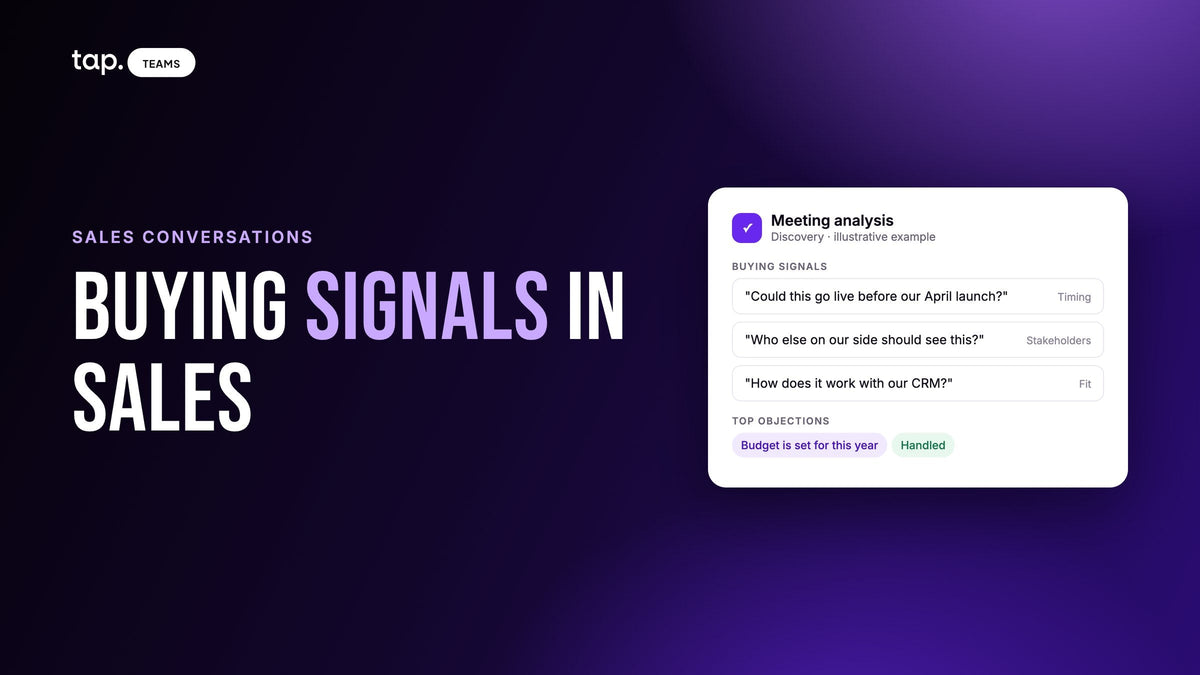
A buying signal is anything a prospect says or does that shows they're moving toward a purchase. It might be a question about setup time, a mention of budget, or a colleague pulled into the conversation. Signals come as statements, questions and behavior. Spotting one tells you when to dig deeper and when to propose a next step.
Most guides to buying signals are written for video calls and email threads. This one spends more time on the conversations that happen face to face, at a stand or across a customer's desk, where signals are easiest to read and easiest to lose. It's part of our guide to meeting intelligence for field sales.
What counts as a buying signal
A buyer showing interest isn't the same as a buyer showing intent. Plenty of people find your product interesting. A buying signal is narrower: the buyer starts thinking about what owning it would look like. They ask how it would work in their team, what it would take to get started, who else would need to agree.
The useful test is whose situation the conversation is about. When the buyer asks about your product in general, they're curious. When they ask about your product in their building, with their people and their deadlines, they've started buying, even if they haven't decided anything yet.
Marketers also use "buying signals" for things that happen away from the conversation, like visits to your pricing page or a company opening a new office. Those help you decide who to contact. This article is about the signals you hear and see while you're talking to someone.
Types of buying signals in a sales conversation
Signals in a conversation fall into three rough groups. The lines between them are blurry, and noticing a signal matters more than filing it correctly.

Statements
These are things the buyer volunteers. They describe a problem in detail and come back to it. They complain about their current supplier. They mention a date ("we have to sort this before the next audit") or a budget cycle. They start using ownership language: "our team would," "when we roll this out," "the reps would probably use it for." That shift from "you" and "your product" to "we" and "our" is one of the most reliable verbal buying signals there is, and it's easy to miss because it's so small.
Questions
Questions are the most common signal, and the most useful ones are about the buyer's own circumstances. How long does setup take? Does it work with the CRM we use? Can we start with one region? What does support look like after we sign? Who else do you work with in our industry? Questions about price, terms, contracts and implementation all point the same way: the buyer is checking whether a purchase is workable, which is a step past whether it's interesting.
"What would the next step be?" is the clearest question you'll ever get. Answer it directly.
Behavior
Non-verbal buying signals are what the buyer does. In person, they're often the first thing you notice: the buyer leans in, slows down, starts taking notes, picks up the product and tries it, or turns your brochure over to read the back. They might wave a colleague over, or take a second card "for someone in our office." They might stop checking their phone, or suggest you both sit down.
Behavior counts after the meeting too. A buyer who replies quickly or sends the document you asked for is telling you something.
Read body language with some caution. People differ, and so do cultures. Crossed arms can mean a cold room. A buyer who nods along may be being polite. Treat behavior as a reason to ask a question, and let the answer tell you what it meant.
Examples of buying signals, and what to ask next
Here are common buying signals, roughly what each one tends to mean, and a question that moves the conversation on. They're examples. Your own buyers will have their own versions.
| What the buyer says or does | What it usually means | A good next question |
|---|---|---|
| "How long does setup take?" | They're picturing the rollout | "What date are you working back from?" |
| "Does it work with our CRM?" | They're checking fit with what they already run | "Which one, and who looks after it?" |
| "What would something like this cost?" | Budget is on their mind, or they're comparing | "What are you comparing it with?" |
| "Our current supplier keeps letting us down" | There's a reason to switch | "What happened the last time?" |
| "We'd need this before the busy season" | There's a deadline | "What happens if it slips past that?" |
| "Who else uses this in our industry?" | They want to reduce their own risk | "What would you want to ask them?" |
| "My manager would have to see this" | They're mapping the decision | "What will they want to know first?" |
| Calls a colleague over | They want a second opinion now | "What does your colleague look after?" |
| Picks up the product and tries it | They're testing it against their own use | "How would your team use it day to day?" |
| "What would the next step be?" | They're ready to move | Answer it, then agree on a date |
Most of the good responses are questions. A signal tells you the buyer is open to more, and the question finds out how much more.
Strong signals and weak ones
Not every signal deserves the same response. A few things separate a strong signal from a weak one.
A buyer who asks about price on their own has told you more than one who says "sure, roughly what would it cost?" after you brought it up. Signals the buyer raises unprompted count for more.
Detail matters as well. "Could we run it for the Cairo team first, then the rest of the region?" is a strong signal. "Is it scalable?" is closer to curiosity.
So does repetition. One question about integration might be habit, since some buyers ask every vendor the same thing. Integration plus a deadline plus a colleague called over is a pattern.
Who's speaking matters. A junior engineer who loves your product and an operations director who quietly asks about contract length are giving you very different news. Both are worth hearing. Only one of them can sign. (If you score leads, this is the same reason seniority and buying role carry weight in a lead score.)
False signals: polite interest vs real intent
The most expensive mistake with buying signals is reading politeness as intent. People are nice to salespeople, especially in person. They nod, they say "this is really interesting," they take the brochure. None of it costs them anything.

These are the ones that most often fool a rep:
- "Sounds interesting, send me something." Sometimes genuine. Often the polite way to end the conversation.
- A price question with nothing after it. The buyer may be checking you're out of their range so they can move on.
- Enthusiasm from someone who can't tell you who decides, or how.
- Lots of feature questions and no questions about their own team. That's research, maybe for a competitor's evaluation.
- A quick "yes, let's talk next week" with no date. Ask for the date and see what happens.
Negative signals are worth knowing too: a buyer who won't say what budget looks like, won't introduce you to the person who decides, keeps saying they're "still looking," or goes vague when you ask about timing. One of these isn't a verdict. Several, from the person who matters, usually are.
The easiest way to tell real from polite is to ask for something small. A second meeting with a date in it. An introduction to the person who looks after their systems. A copy of their current process. Buyers with real intent say yes to small commitments. Polite ones find a reason not to, and you've learned something useful without wasting a follow-up sequence on them.
What to do when you hear a buying signal
Most advice says to act on a signal fast. I'd add that the right action is usually smaller than a close.

- Stop talking. A rep who hears "how long does setup take?" and launches into the full implementation story has answered a question the buyer didn't ask. Answer briefly, then hand the conversation back. Reps who talk too much tend to talk straight over signals, which is one reason the talk-to-listen ratio is worth watching.
- Ask what's behind it. "Setup time matters to you. What are you working toward?" The answer tells you whether this is a real deadline or idle curiosity, and it usually tells you something you didn't know.
- Play it back. "So you'd need it running before the audit, and your IT lead would have to sign off. Is that right?" If you're right, the buyer has now said it twice. If you're wrong, they'll correct you.
- Propose a specific next step that fits the signal. A question about integration earns a call with their admin. A question about rollout earns a planning conversation with whoever owns the date. A signal from someone without authority earns a meeting that includes someone with it.
- Write it down, in their words, before the next conversation starts.
One thing to avoid: pouncing. If a buyer asks about price in the first five minutes and you reply with a discount and a contract, you'll lose a buyer who was only getting oriented. Match the size of your response to the size of the signal.
Reading buying signals face to face
In-person selling gives you more signals than any call. You can see where the buyer's attention goes, who they glance at when price comes up, whether they pick the product up or keep their hands in their pockets. You also have far less time to do anything with them.
Take a trade show. A visitor stops at your stand, asks whether your system works offline, then asks whether you could support three sites. They call a colleague over to listen. That's a cluster of strong signals in four minutes. Then they leave, you're straight into the next conversation, and by the evening the badge scan is all that's left. The question about three sites is gone, and so is the colleague's name. You heard every signal and kept none of them.
Watch the group, not just the person in front of you. At a stand or in a client's office, the most useful signal is often from the second person: the colleague who goes quiet when the first one mentions budget, or the one who asks a sharp technical question from the back. Find out who they are before they leave.
Use the pause. When a buyer picks up the product or stops to reread something, let them. Then ask what they were looking at. It's the in-person version of waiting a beat after an answer.
On a short visit (a corridor conversation with a physician, a few minutes with a site manager between jobs), you won't get a long list of signals. Listen for one: a date, a name, a problem they described in detail. One clear signal on a short visit is worth acting on.
Ask for the commitment while you're standing there. "Shall we pick a time next week with your colleague?" is much easier to agree to in person than in a follow-up email four days later.
Capturing buying signals before you forget them
Buying signals are only useful if they survive the conversation. A rep who heard "we'd need it before the audit" and wrote down "good chat, follow up" has lost the most important thing the buyer said.
Write a short note straight after, using the buyer's words. "Wants it before the audit. IT lead is Karim, needs to see the integration." That's enough. A note written that evening is weaker, and one written the next morning is mostly invention.
Record the conversation if the other person agrees. A recording keeps the exact words, the order they came in, and the questions you didn't think to write down. Recording someone requires their knowledge, and in many places their consent, and the rules differ by country and sometimes by state. Ask at the start, every time. If they'd rather not, put the phone away and write the note. Meeting intelligence software can then pull the buying signals out of the transcript for you, which matters most on the days when you have the most conversations and the least time.
Attach the signals to the lead. Signals kept in a notebook or a rep's memory don't reach the CRM, the manager, or whoever picks up the account later. Put them where the follow-up gets written, so the email mentions the audit and the three sites instead of saying "great to meet you."
Use them to decide who to call first. After an event, a lead who asked about rollout and named a decision maker should go to the top of the list, whatever the badge says.
Using buying signals in coaching
Managers rarely hear the conversations their field reps have. Buying signals give you something concrete to review when you do.
Look for signals the rep missed. A buyer asked about rollout and the rep kept presenting. A buyer named their manager and the rep never asked to meet them. These are the moments worth playing back in a one-to-one, because the rep can hear exactly what the buyer said and what they could have asked.
A meeting full of strong signals with no next step agreed points to a closing habit, and that's fixable too.
Across the team, the same question heard by many reps tells you something about the market. If buyers keep asking about one integration, the answer might belong in the pitch, or the gap in the product.
How Tap handles this
In Tap, a rep records a meeting against the lead they're talking to, or uploads a recording they already have, after telling the other person they're recording. Tap transcribes it and analyzes it into a summary, key topics, buying signals (moments the lead moved toward a decision), top objections you can mark as handled, speaking time and sentiment. Action items become follow-ups, and when analysis finishes, the summary and action items sync to the lead's CRM record as a task.
For questions the analysis didn't answer, Ask AI on the meeting takes a plain question, like "what did they say about timing?", and cites the moment in the recording it came from. Competitors named in the conversation are counted across the team in Competitors, and managers see the topics and objections coming up across everyone's recorded meetings.
There's more on the meeting intelligence page, or you can book a demo and see it on a conversation like yours.
FAQ
What are buying signals in sales?
Buying signals are things a prospect says or does that show they're moving toward a purchase. They include questions about price, setup or contracts, statements about deadlines or problems with a current supplier, and behavior like bringing in a colleague or asking what the next step is.
What are examples of verbal buying signals?
Common verbal buying signals include "How long does setup take?", "Does it work with our CRM?", "What would the next step be?", "My manager would need to see this," and any switch to ownership language such as "our team would use it for." Questions about the buyer's own situation are stronger than general questions about the product.
What are non-verbal buying signals?
Non-verbal buying signals include leaning in, taking notes, handling or testing the product, calling a colleague over, slowing down to reread something, and suggesting you sit down. Body language varies by person and culture, so treat it as a prompt to ask a question, not proof of intent.
What are negative buying signals?
Negative buying signals suggest a prospect isn't moving forward: they won't share budget, won't introduce the decision maker, keep saying they're still researching, avoid naming a date, or end with a vague "send me something." One alone means little. Several from the person who decides usually mean the deal is stalling.
How do you respond to a buying signal?
Answer briefly, then ask what's behind the signal. Play back what you heard to confirm it, and propose a specific next step that fits, such as a technical call after an integration question. Write down the buyer's exact words before the next conversation, so the follow-up refers to what they actually said.



Leave a comment
This site is protected by hCaptcha and the hCaptcha Privacy Policy and Terms of Service apply.