

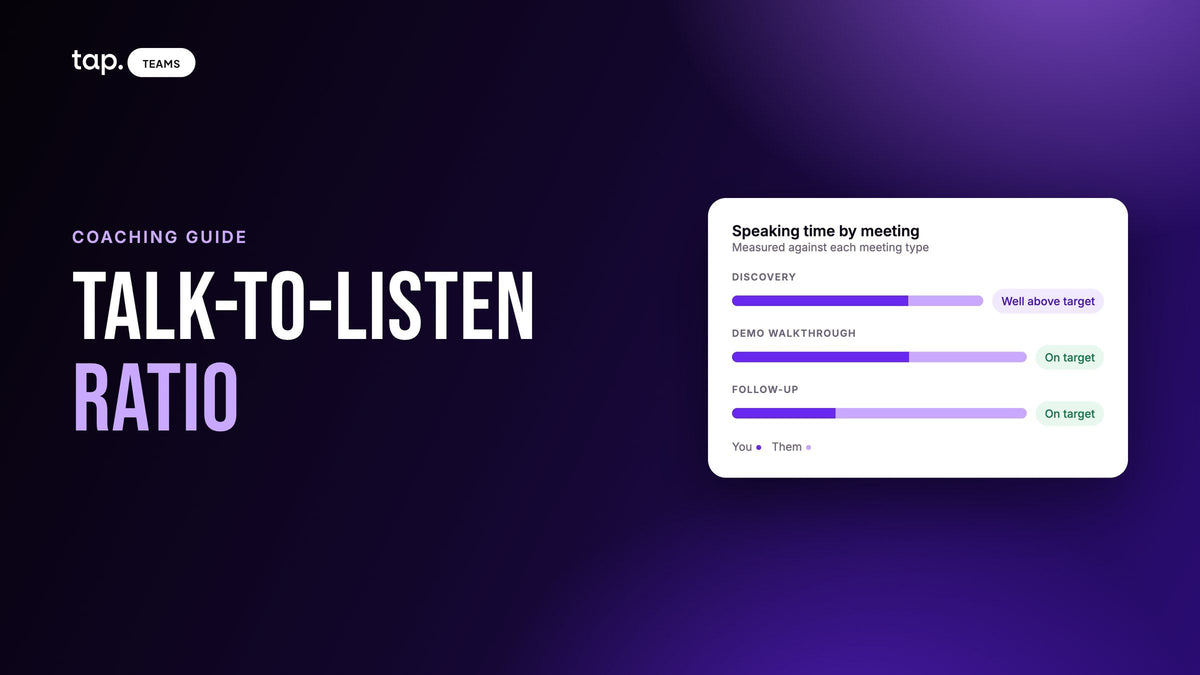
There's no single right talk-to-listen ratio. It's the share of a sales conversation the rep spends speaking, and the right share depends on the meeting. In discovery the buyer should do most of the talking; in a demo or training session the rep will talk more. Set a range for each meeting type from your own best reps.
That's a less satisfying answer than the one at the top of most search results, and I think it's the more useful one. Talk ratio is one piece of meeting intelligence for field sales, and it's usually the piece managers start with, because it's so easy to see.
What is the talk-to-listen ratio?
It's how much of a conversation the rep spent speaking compared with everyone else in it. People usually write it as a split with the rep's share first. Some tools show only the rep's share as a percentage. Same idea.
The ratio measures airtime, and that's all it measures. It can't tell you whether your questions were sharp, whether you understood the answers, or whether the meeting ended with a real next step. The most common way teams misuse it is to treat a "good" ratio as proof of a good meeting.
How to calculate your talk-to-listen ratio
You need a recording, and you need to know who was speaking when. Then:
Rep's talk share = time the rep spoke ÷ (time the rep spoke + time everyone else spoke)
A made-up example to show the arithmetic. Say you record a 40-minute first meeting with an operations manager. You spoke for about 22 minutes and the manager for 14. The last 4 minutes were pauses, a phone call they stepped out for, someone bringing in coffee. Leave those out. Your share is 22 ÷ 36, which is 61%, so the split is 61:39. Is that good? You can't tell yet, because it depends on what the meeting was for. (The numbers are there to show the sum. They aren't a target.)

Two choices change the answer, so make them once and stick with them. Drop silence, or neither side adds up to the whole and meetings get hard to compare. And group people by side: two reps count together as "us", three people from the buyer's company count together as "them". Otherwise a meeting with a big buying group looks like the rep never said a word.
Work one out by hand from a timestamped transcript once, so you know what the software is doing. After that, let conversation intelligence software separate the speakers and add up the time. It's the only realistic way to look at more than a handful of meetings.
Why the ratio matters
Early in a deal, every minute you talk is a minute the buyer isn't telling you something. What you need to win (what's broken, who else cares, what happens if they do nothing, how they'll decide) only comes out of the buyer's mouth. A rep who fills the first meeting with the company story walks out knowing about as much as when they walked in, then writes a proposal on guesses.
There's a quieter cost too. When a buyer describes their own problem out loud, in their own words, it becomes their problem. When the rep describes it for them, it's a pitch, and buyers have sat through plenty of those.
And over-talking is one of the few coaching problems you can put a number on. You can't measure "builds rapport". You can measure "talked through the whole discovery meeting", and once reps see it on a screen, most of them want to fix it.
The problem with the magic number
Search for the ideal talk time on a sales call and you'll see a single magic number quoted everywhere, usually as a precise-looking split. It came out of analysis of recorded phone and video calls, and it gets repeated as if it applied to every sales conversation ever held. It doesn't transfer well to field sales.
For a start, it blends meeting types. One average across first calls, demos and pricing talks describes none of them. A rep whose discovery meetings hit that average is probably talking too much in discovery, and a rep whose demos hit it may be rushing the product.
In-person meetings also don't run like calls. At a trade show booth the rep has to open with a short explanation to someone who's just stopped walking. On a clinic or office visit, the buyer might give you a few minutes in a corridor and expect you to get to the point. Across a table from three people on the buyer's side, the conversation moves between them, so "the buyer's share" is really a group's share.
Then there's what you sell. A team explaining a complex product to engineers will talk more than a team selling a simple service to owners who already know what they want.
So keep the instinct behind the number (you should probably listen more than feels natural) and forget the decimal.
How much should a salesperson talk? It depends on the meeting
The table gives direction for each common meeting type. It has no percentages on purpose; those should come from your own recordings, as the next section explains.
| Meeting type | What it's for | Who should talk most |
|---|---|---|
| Discovery | Learning the buyer's situation, problem and how they decide | The buyer, clearly |
| Cold prospecting | Earning a second conversation | The rep opens; after that the buyer has to engage or there's no meeting |
| Demo walkthrough | Showing how the product solves what discovery found | The rep, with regular stops for questions |
| Negotiation and closing | Agreeing terms and next steps | Closer to even; listen hard to every objection |
| Follow-up | Picking up where the last meeting ended | The buyer, on what's changed since |
| Onboarding and training | Getting a new customer using the product | The rep, by design |
| Troubleshooting and support | Understanding and fixing a problem | The customer first, then the rep |
Discovery is where the ratio earns its keep. Its whole job is to hear the buyer, and everything later in the deal is built on what it found.
Talk time within a single meeting
The balance shifts inside one conversation, too. A first meeting usually runs something like this:
- The opening. You'll talk more here: who you are, why you asked for the time, what you'd like to cover. Keep it short and end on a question.
- Questions. The buyer should be doing most of the talking. If your share climbs here, you've started pitching.
- Your point of view. Once you understand the problem, you explain how you'd approach it, and your share goes up. That's fine.
- Objections. Hear the whole objection before you answer it.
- Next steps. Short, specific, agreed by both sides.

A whole-meeting ratio hides this shape. If a discovery meeting comes back rep-heavy, skip to the middle of the recording first. That's usually where it went wrong.
How to set talk-ratio targets from your own best reps
The best benchmark you'll find is already in your recordings.
- Tag every recorded meeting with its type. Otherwise you're averaging demos with discovery calls, and the result means nothing.
- Pick your top performers by outcome, using results you already trust: deals won, first meetings that turned into second meetings, accounts that grew. If you pick them by their ratio, you've chosen the answer before asking the question.
- Look at their meetings one type at a time, with enough meetings in each pile to see a normal band.
- Set a range. Good reps vary from meeting to meeting, and a range that covers your strong reps on an ordinary day is more honest than a point they'd miss half the time.
- Listen to the outliers. When a meeting lands well outside the range, open the recording. Sometimes you'll find a coaching moment. Sometimes the buyer asked for a long technical explanation and the rep was right to give one. Either way you learn where the edges of the range belong.
- Revisit the ranges when your product, market or way of selling changes.

A hypothetical: your three strongest reps' discovery meetings consistently show the buyer doing most of the talking, and one newer rep's show the reverse. The number hasn't diagnosed anything. It's told you which recordings to open, and those will show what the new rep is actually doing.
Why reps talk too much (and sometimes too little)
Over-talking is rarely ego. Most reps who do it are nervous or excited about the product. The habits behind it look similar across teams:
- The buyer pauses to think, and the rep fills the gap, usually with a pitch.
- The rep asks closed questions. "Is reporting a problem for you?" gets a yes or a no, so the rep has to keep talking to keep things moving.
- They hear a keyword and launch into the matching feature before the buyer finishes the sentence.
- They spot the fit early and start selling before the problem has been fully described.
- Three questions come out in one breath, and the buyer answers the easiest.
The opposite problem gets less attention. Some reps, usually right after being told to "listen more", turn discovery into an interrogation: question after question off a checklist, no reaction, no point of view. The buyer's answers get shorter. A very low discovery ratio deserves a listen too, because buyers want to talk to someone who knows the territory and will offer an observation now and then.
How to talk less without going quiet
These are the techniques I'd teach a new rep first. None of them needs a script.
Ask open questions that invite a story. "Walk me through what happens after a lead comes in" gets you far more than "Do you follow up quickly?" Stories carry the specifics: who's involved, where it breaks, what it costs.
Ask one question, then stop. Don't tack on a second question or an example of the answer you're hoping for.
Get comfortable with a pause. When the buyer finishes an answer, wait a beat. The first answer is often the rehearsed one, and the useful part tends to come after a short silence.
Follow their words. Pick up a phrase the buyer used and ask about it: "You said the numbers arrive late. Late for what?" It proves you were listening and takes you somewhere a prepared question wouldn't.
Summarize back. "So the issue is that the data shows up after the decision's been made?" If you're right, they'll keep going. If you're wrong, they'll correct you, and the correction is often the most useful thing said all meeting.
Watch your monologues. A ratio is an average, and an average can hide one long speech in an otherwise balanced meeting. When you have to explain something, make one point, then check in ("Does that match how it works on your side?") before the next. A good drill: find your longest uninterrupted stretch on a recent recording, play it back, and ask whether the buyer could have got a word in.
Park the pitch. When a feature pops into your head mid-answer, jot it down. You'll make the point better once you know the whole problem.
Talk ratio in face-to-face meetings
Most talk-time advice assumes a video call with two people and clean audio. Field sales is messier.
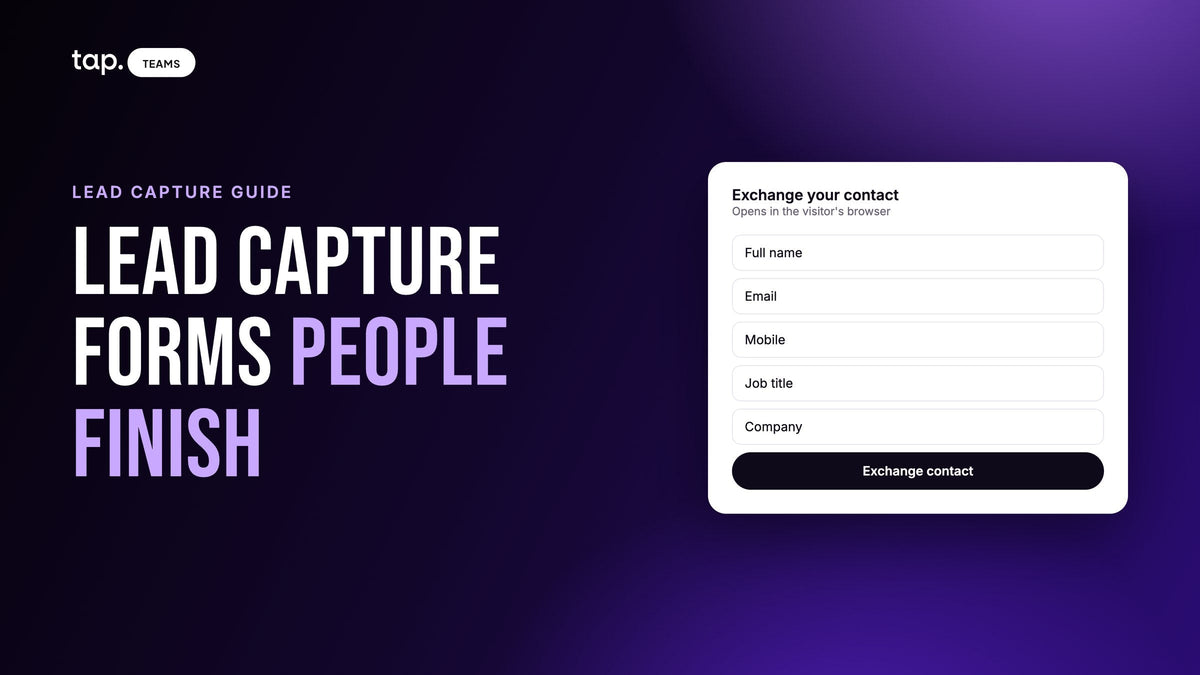
At a booth, conversations are short and nearly always open with the rep explaining what the company does. A rep-heavy start is normal. What matters is whether the rep turns it into a conversation once the visitor stays, and captures their details and interest while it's fresh (a well-built lead capture form does much of that work).
On a clinic or site visit, the buyer may have very little time and expect you to present something specific. You'll talk more, and that's fine. If every visit comes back as a monologue, though, find out whether the customer ever gets asked anything.
When several people from the buyer's side are in the room, the ratio says less about listening and more about whether the room was engaged. Check that everyone on their side was counted as "them".
In a noisy room, transcription and speaker separation both get harder. Put the phone on the table between you, not in a pocket, and say the other person's name early. When the audio is bad, trust the number less. And tell people you're recording before you start; in many places that's a legal requirement.
How managers should use talk ratio
Over-talking is invisible until it's measured and pretty fixable once it is, which makes talk ratio one of the most practical coaching signals a field sales manager has. Used badly, it turns into a number reps learn to game.
Use it as the reason to open a recording. The ratio tells you where to look; the recording tells you what happened. Coach from the number alone and you'll end up arguing about percentages instead of the meeting.
Look for patterns. One long-winded discovery meeting is a bad day. A month of them is a habit, and habits are what coaching is for.
Keep it off leaderboards. Rank reps on talk ratio and they'll learn to go quiet, which isn't listening. You'll get the interrogation problem instead.
Let the rep hear it before you say anything. Pick a two-minute stretch, play it together, and ask what they'd do differently. Hearing yourself talk over a buyer lands harder than being told you did.
Read it next to outcomes. A rep with an awkward ratio and a healthy pipeline is telling you something about your ranges. It's the same caution that applies to lead scores: the number tells you where to look.
Before coaching from any single result, rule out the boring explanations: a recording too short to judge, one that started late and missed the buyer's long first answer, a demo tagged as discovery, or noise and mixed languages confusing the speaker separation.
How Tap measures talk ratio
In Tap, every recorded meeting has a type: Discovery, Cold prospecting, Demo walkthrough, Negotiation and closing, Onboarding and training, Troubleshooting and support, Follow-up, or General. The type decides which target the analysis measures you against. Discovery has a low target, because you should be listening, and a demo walkthrough legitimately has you talking more. If a meeting was tagged wrong, you can change the type afterwards.
Tap transcribes the recording, separates the speakers, and measures your share of the conversation. The result reads On target, Above target, Well above target, Below target, or Not enough data when the recording was too short or unclear to judge. "Well above target" on a discovery meeting is the one worth acting on. Listen to the recording, or open Ask AI on the meeting and ask where the pitch started; its answers cite the moment in the recording they came from. The same analysis produces a summary, key topics, buying signals and objections, so the ratio sits next to what was actually said.
If most of your reps' meetings happen in person, book a demo of Tap Teams to see it on those conversations.
FAQ
What is a good talk-to-listen ratio in sales?
It depends on the meeting type. In discovery, the buyer should do most of the talking. In a demo or training session, the rep talking more is expected. The most reliable targets come from measuring your own top performers one meeting type at a time and setting a range from what they do.
How do you calculate talk-to-listen ratio?
Record the conversation, separate the speakers, add up each side's speaking time, and divide the rep's time by the total speaking time. Leave silence out and group everyone from the buyer's side together. Very short or noisy recordings give unreliable results.
How much should a salesperson talk on a discovery call?
Less than the buyer, clearly. Discovery exists to learn the buyer's situation, and you can't learn it while you're talking. If a rep keeps dominating discovery meetings, listen to a few to find the habit behind it. It's usually filling silences or pitching too early.
How long should a sales monologue be?
Short enough that the buyer could comfortably have jumped in. When you need to explain something at length, break it into points and check in with a question after each. To see where you stand, find your longest uninterrupted stretch on a recent recording and listen to it.
Is talking less always better in sales?
No. A quiet rep who asks weak questions learns nothing, and a rep explaining a detail the buyer asked for may rightly talk more. Use the ratio to decide which recordings to review, then judge the conversation itself.

Leave a comment
This site is protected by hCaptcha and the hCaptcha Privacy Policy and Terms of Service apply.