
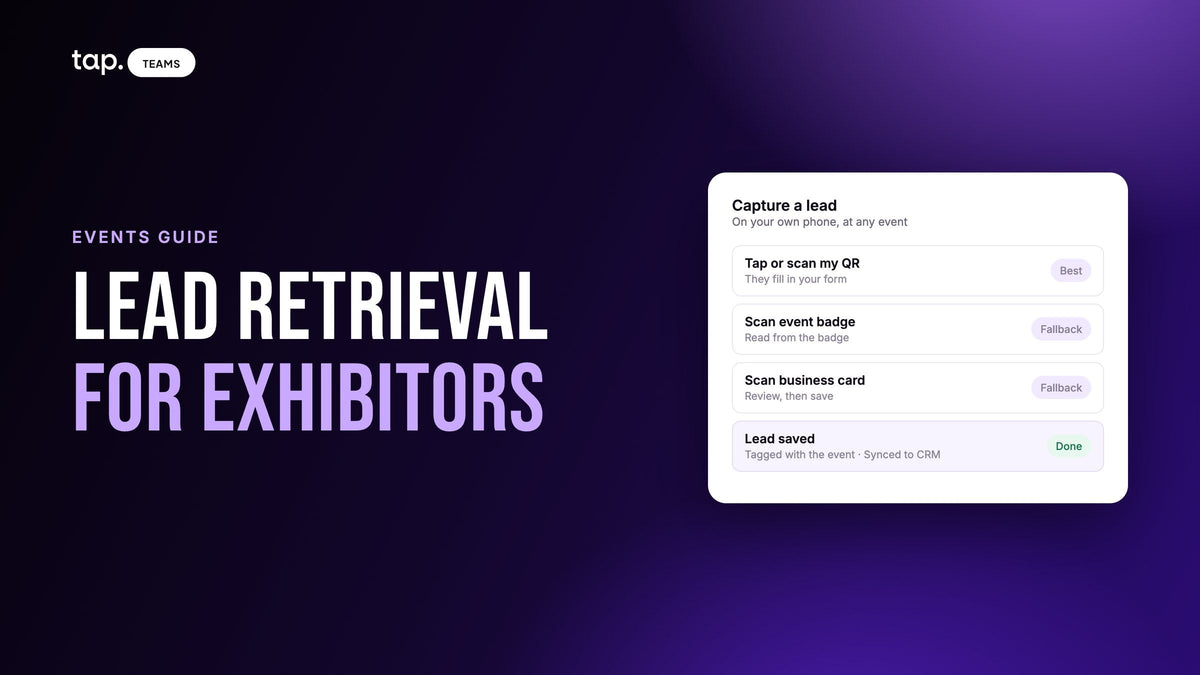
Lead retrieval is how exhibitors collect the contact details of people who stop at their booth during a trade show or conference. In the usual setup, a rep scans the visitor's badge with a device or app licensed from the event organizer, and the organizer releases that attendee's registration record to the exhibitor during or after the show.
That's the textbook version, and at plenty of shows it's all you need. Anyone who has worked a booth for a few days knows the scan is the easy part, though. The hard part comes on the flight home, when you're scrolling an export and trying to remember which badge belonged to the person who asked about a second site.
How lead retrieval works at a trade show
It starts weeks before the show, when attendees register. They fill in the organizer's form with their name, company, job title, email and whatever else the organizer decided to ask. Each registration gets a code, which ends up printed on the badge as a barcode, a QR code or an ID number. Some badges carry a chip instead.
At the booth, the rep scans the badge. Often the code holds little more than an attendee ID, and the scanner looks that ID up in the registration database. That's why the organizer runs the whole process: their system is the one that can turn the code into a person.
Most lead retrieval apps then let the rep add something of their own, like a rating, answers to a couple of qualifying questions, or a short note. Leads collect in an exhibitor portal, and you download them as a spreadsheet during the show or after it closes. Some systems can push leads into a CRM. Many leave that step to you.

Types of lead retrieval tools
You'll usually see four setups on the same show floor, sometimes at the same booth.
Rented handheld scanners
A dedicated device you collect from the organizer's service desk on day one and hand back on the last. If you've stood in that queue while your booth still had no power, you know the routine. They're quick. You get as many as you rented, and at a busy booth that can mean reps passing one scanner back and forth.
The organizer's app on your own phones
Many shows now license an app instead. Each rep downloads it, signs in with an event code and scans badges with the phone camera. There's nothing to return, but it's still the organizer's system: the login stops working when the show ends, and next month's event may use a different app altogether.
An independent lead capture app
This one belongs to your company, goes to every event with your reps and doesn't touch the organizer's database. Typically the visitor taps a phone or scans a QR code and types their own details into a short form, and the rep scans a card or badge when a form isn't practical. Leads go into your CRM as they're captured.
Business cards and a notebook
Still the default at a lot of booths, and still the reason someone spends the week after the show typing. We've written about why a stack of cards feels like more progress than it is.
| Rented scanner | Organizer's app | Your own capture app | |
|---|---|---|---|
| Who controls it | The organizer | The organizer | Your team |
| Where it works | That show floor | That show floor | Any event, dinner or customer visit |
| What you capture | Registration data | Registration data, plus notes and ratings | Your own form, plus card and badge scans |
| When leads reach your CRM | After an export and import | Depends on the event's setup | As they're captured |
Lead retrieval vs lead capture
People use the two terms interchangeably. Strictly speaking, lead retrieval means pulling an attendee's record out of the organizer's registration data. Lead capture means you collect the details yourself, with your own form and your own questions, so you never wait for anyone to release them. Most exhibitors end up doing some of both.

Where organizer lead retrieval falls short
Most of the limits come from the system belonging to the event instead of to your sales team.
Each show has its own login and its own export format. When you sit down next year to compare three shows, you're lining up spreadsheets with different columns.
You also get exactly what registration asked for, typed weeks earlier for the organizer's purposes. If someone registered with a personal email and skipped the phone field, that's your lead. You can't go back and add a question.
Then there's the delay. Somebody has to download the file, fix the columns, import it and assign owners. By the time that's done, the rep is on another trip and the lead has gone cold.
A scan also carries no conversation. It proves someone stopped by. It won't tell you they're unhappy with their current supplier and their contract is up in the spring. Ratings and notes fields help, but only if reps fill them in, which is hard to do mid-afternoon at a crowded booth.
And it only works on the show floor. Some of the best conversations of the week happen at the dinner or in the hotel lobby, where nobody is scanning badges. The meeting at a customer's office the morning after has no badge at all.
When the organizer's scanner is still the right call
Don't drop it on principle. If the badge code only points to the organizer's database, their system is the only one that can read it in full. For a booth that wants a record of every passer-by, like a giveaway with a long line, a badge scan is faster than any form.
At some professional events, registration is checked against credentials, and the badge record is more reliable than anything a visitor will tell you in a noisy hall.
Some organizers restrict how exhibitors may collect or use attendee data, and their scanner is the sanctioned route. Check the exhibitor manual before you decide.
And if lead retrieval already comes with your booth package, the cost argument goes away. Use it.
You don't have to pick one. A sensible setup is badge scans for quick traffic and your own capture for the conversations you'll actually follow up on.
How to choose a lead retrieval app
If your team exhibits more than a couple of times a year, ask these in any demo:
- Does it work at an event with no lead retrieval program, and at a customer meeting the next day?
- Can visitors type their own details on their own phone without installing anything?
- When a form won't work, can it scan business cards, badges and QR codes, and does it show you what it read before saving?
- Can you add your own qualifying questions, and will the answers map to fields in your CRM?
- Can a rep qualify a lead in a few seconds after the conversation, with a buying role, a rating or a note?
- Can it keep the conversation itself, as notes or a recording made with the visitor's consent?
- What happens when the hall's network drops? Captures made offline should sync once the phone reconnects.
- Does each lead reach the CRM as it's captured, owned by the rep who met the person?
- Can you tag leads by event, in bulk, so "which show was worth it" becomes a filter?
- Is there a score or tier that sorts the follow-up list before anyone opens it?
- Can a manager see the whole team's leads without asking anyone to forward a spreadsheet?
Pay attention to the review-before-save step. A single misread character in an email address is a lead you can never contact, and at a dim booth with glossy cards, misreads happen.
Whatever you pick, do two things before anyone travels. Agree the event tag name, so nobody invents their own spelling. And confirm every rep's account can sync to the CRM, because a rep without access captures leads perfectly and syncs none of them.
Qualifying leads at the booth
Qualification happens in the moment after the visitor walks away, or it mostly doesn't happen. The rep who spoke to them knows things no form will: whether they were only being polite, and what they asked about twice.
Custom questions help if you keep them to one or two. "Which product are you here about?" is worth asking at a busy booth. A five-question form gets abandoned halfway. Our guide to lead capture form design goes through which fields earn their place.
After that, the rep sets a buying role (decision maker, influencer, end user or gatekeeper) and writes one line in their own words. "Wants pricing for a second site, current contract ends in spring" is the line that makes the follow-up call worth taking. For longer conversations, a recording keeps what a quick note loses. Tell the other person you're recording before you start; the rules differ by country. Meeting intelligence for field sales covers what a team can do with those recordings.

After the show: follow-up and ROI
If the leads are already in the CRM, tagged and sorted, a rep can send the first follow-ups from the departure gate. If they're sitting in an export nobody has opened, they'll wait until someone finds a free afternoon, and by then the conversation is a blur on both sides.
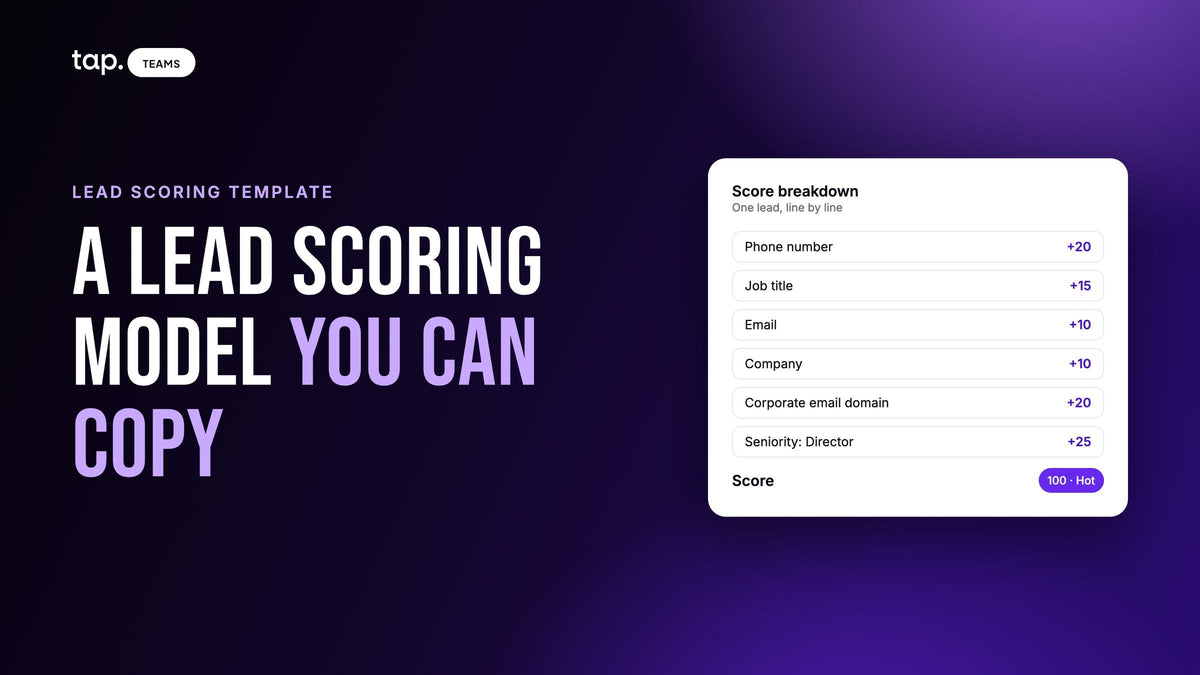
Say your team comes back with two hundred leads. Sort by score, start at the top, and read the rep's note or meeting summary before each call, because a score can't hear what was said. The lead scoring guide explains how to build a score that holds up for event leads. Leads that came in as a name and an email can be filled out with lead enrichment before anyone picks up the phone.
Measuring ROI is mostly a counting exercise once every lead carries the event tag. Count the leads from the show, then the meetings, the opportunities and what those opportunities are worth, and put that next to what the show cost all-in. It won't be exact, because deals from a show can close months later. Measured the same way every time, though, it tells you which shows to book again.
How Tap handles event lead retrieval
Tap is a lead capture app your team uses on their own phones, at any event and in any meeting. Reps share their profile by NFC tap, QR code or link. The visitor sees it in their browser with nothing to install, fills in your capture form, and the lead is created the moment they submit. The collecting leads docs walk through the flow.
When a form isn't practical, the scanner reads business cards, QR codes and event badges. For a card, it shows the rep what it read so they can check it before saving. A scanned lead scores, syncs to your CRM and takes meetings and follow-ups the same way a form lead does. The scanning docs cover getting clean scans under booth lighting.
Right after a lead is saved, the app asks for their buying role, which feeds the lead score (shown in the app as Hot, Warm or Cold); reps can skip it and fill it in later. They can add notes, or record the conversation to get a summary, buying signals and objections. Tags go on one lead at a time or in bulk. Leads reach your CRM within seconds, owned by the right rep, and anything captured while the phone was offline syncs when it reconnects.
If your team exhibits several times a year, see how Tap works for sales teams or book a free demo.
FAQ
What is the difference between lead retrieval and lead capture?
Lead retrieval pulls an attendee's registration record from the organizer's system, usually by scanning their badge. Lead capture means collecting the details yourself, with your own form and questions, so the data is yours from the start and doesn't wait on an export.
Can I use my own phone for lead retrieval?
Yes, in two ways. Many organizers license an app that turns your phone into a badge scanner for that event. Or you can use an independent lead capture app that works at any event and sends leads to your CRM. The one limit: if a badge code only points to the organizer's database, only their system can look it up.
Does a lead retrieval app work without wifi?
Many do. They store scans on the phone and sync once it reconnects. A form the visitor fills in on their own phone still needs their phone to have a signal, so capture a test lead on the venue network before the doors open.
Do I still need the organizer's badge scanner?
Sometimes. It makes sense when only the organizer's system can read the badges, when the organizer restricts how exhibitors use attendee data, or when it already comes with your booth. You can run it alongside your own capture app.
Which trade show leads should I follow up with first?
Start with the highest-scoring leads, using a score built from what was captured: phone number, job title, a corporate email and buying role. Then read the rep's note before each call, since a score can't tell you what was said.

Leave a comment
This site is protected by hCaptcha and the hCaptcha Privacy Policy and Terms of Service apply.