
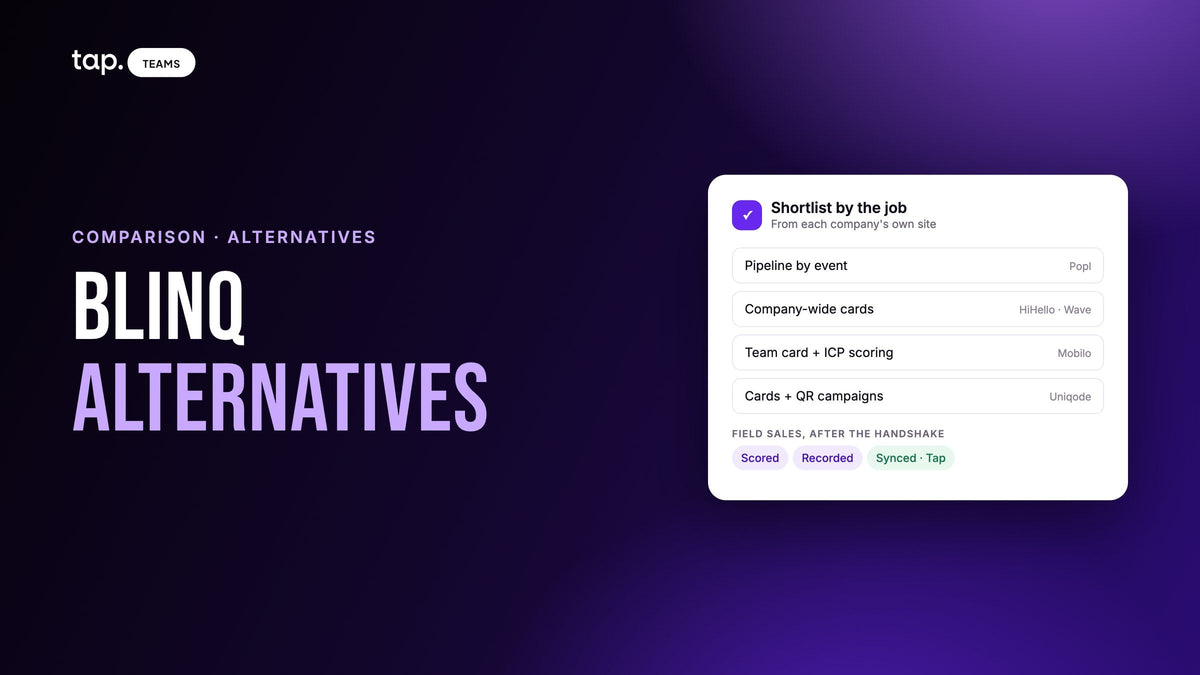
The main Blinq alternatives for sales teams are Popl, HiHello, Mobilo, Wave Connect, Uniqode and Tap. Popl is built around event lead capture. HiHello and Wave suit company-wide card rollouts. Mobilo scores leads against your ideal customer. Uniqode pairs cards with QR codes. Tap fits field sales teams that need each lead scored, recorded and synced to the CRM.
Most people typing "Blinq alternatives" aren't unhappy with Blinq. One part of it doesn't match their team, or they're shortlisting before they buy. This guide takes six alternatives one at a time, describes each using only what its own website says (checked on 19 October 2026), and says plainly where each is a better fit than Blinq and where Blinq is still the better choice. If you want Blinq and Tap side by side, read Tap vs Blinq. If Popl is the tool you're leaving, our Popl alternatives guide covers that list.
What Blinq is today
Blinq's homepage calls it "the AI contacts platform for the real world." It started as a digital business card and still leads with one: free to start, shared by QR, tap, link or wallet, with nothing for the recipient to download. Around the card sit a scanner that reads badges, paper cards, QR codes and LinkedIn profiles offline, AI enrichment that fills in title, phone, email and LinkedIn, an AI Notetaker that records in-person conversations and phone calls, and native CRM integrations with campaign attribution per event. Blinq MCP connects your contacts to Claude, ChatGPT or Copilot. For companies, the enterprise page documents SAML SSO, SCIM provisioning, brand locked at the template level, and email signatures deployed to Google Workspace and Outlook with nothing for employees to install.
That's a wide product, which is why people go looking. An events team wants a tool whose whole design is the booth. A field sales team sells in clinics and on job sites, where there are no badges, and wants the meeting analyzed, not only transcribed. A marketing team wants cards, signatures and QR codes reported together. Each group ends up with a different shortlist, and the sections below are organized so you can find yours.
What to look for in a Blinq alternative
Before comparing scanners and integrations, answer five questions about your own team.
- Who needs it? One person, a sales team, or every employee. A whole-company rollout is an IT project and needs directory provisioning. A sales team needs templates and a manager who can see the leads. One person needs a card.
- Where do you meet people? Trade show booths reward badge scanning, offline capture and per-event reporting. Field visits reward the meeting record, because there's no badge to scan and the conversation is the whole asset.
- What happens after the capture? This is where the tools differ most. Some stop at a saved contact. Others rank the lead, fill in missing fields, record and analyze the conversation, and decide who owns the record in the CRM.
- Which CRM, and which record type? Check your CRM is native rather than reached through Zapier, and ask whether a stranger from a booth arrives as a Lead or a Contact. Our guide to digital business cards with CRM integration covers why that matters.
- Who runs it day to day? If IT does, look for SSO, SCIM and audit logs. If a sales manager does, look for templates, sub-teams and the view across reps.

The Blinq alternatives, one by one
Each tool gets the same treatment: what it is, how it compares to Blinq, when it's the better fit, and what to check. Everything comes from the company's own site. Where a site says nothing about a feature, we say so rather than guess.
1. Popl
Popl's homepage calls it "your AI GTM platform for in-person events," and the product is organized around that: a universal badge scanner that Popl says works at any event, even when the organizer provides its own scanning hardware or app, AI enrichment of each scanned contact, Event Flows with qualifying questions and auto-tags per event, AI Voice recording of booth conversations, attribution reporting, and an assistant called Ask Popl. Digital business cards are still there for teams, and the pricing FAQ mentions a simple card app for solo professionals.
Compared to Blinq, Popl is the more booth-shaped product. Blinq treats event capture as one of several things the card can do; Popl treats the event as the center and the card as an accessory. Popl's FAQ says its scanner reads the printed name and company on a badge and enriches from there, so it doesn't depend on decoding an organizer's QR code, and that leads are stored on the device when the hall's network drops. Its lead qualifiers are set per Event Flow, with examples like "Is this a decision maker?" and a Hot, Warm or Cold status that reps answer in the app. Popl lists native integrations with Salesforce, HubSpot, Marketo, Microsoft Dynamics, Zoho, Pipedrive, Pardot and monday.com, plus Slack and SAML login through Okta and Azure.
Better fit when your team's year is a calendar of trade shows and someone has to report pipeline by event.
What to check: Popl's pages describe transcribing conversations with insights and next steps, but not a per-meeting talk ratio or objection list, and an automatic lead score isn't described. If your people mostly sell away from booths, test whether the event-first layout suits a Tuesday site visit.
2. HiHello
HiHello describes itself as "the professional presence and lead capture platform": digital business cards, email signatures, virtual backgrounds and a company directory managed in one place, plus card and badge scanning into the CRM for the teams who meet customers. The scanner reads paper cards, event badges and QR codes, and can enrich a contact with title, company and LinkedIn in one tap. Its CRM page lists direct sync to Salesforce, HubSpot, Microsoft Dynamics and Marketo, with a choice of whether contacts arrive as Leads or Contacts and tags passed through to segment or route them.
Compared to Blinq, HiHello is the closest cousin on this list. Both sell the card, the signature, the background and the directory as one branded surface, and both document SSO and SCIM. HiHello's enterprise page lists Okta, Entra ID, Workday, Google Workspace and Microsoft 365, and says its email signature delivery is native, so mail never routes through HiHello's servers. Its homepage says it was built for marketers. Blinq's leads with the contact and what you remember about them, and its Notetaker and MCP give it the stronger story for the conversation itself.
Better fit when marketing owns the rollout and the goal is every employee's card, signature and video background staying on brand without anyone policing it. HiHello says individuals and teams start with a free trial, and companies with a hundred or more people get a guided rollout.
What to check: HiHello's pages don't mention offline scanning, an automatic lead score or meeting recording, so confirm those in a demo if they matter. Its CRM list is shorter than Blinq's.
3. Mobilo
Mobilo sells a "digital business card for teams" and describes it as the card that "exchanges contact information, sends text messages, does background research, scores your leads, prioritizes, and pushes all data straight to your CRM." It's the card on this list that leans hardest into what happens after the tap. Leads are enriched with company size, title and industry right after capture, then scored against an ideal customer profile you build from role, region, tech stack and revenue. Scores and tags flow into Salesforce, HubSpot or Microsoft Dynamics for routing. Its events page describes a one-tap lead gen mode with custom questions, NFC, QR and manual scan options, and local capture that syncs when signal returns. Physical cards come in plastic, wood and metal, with a digital card included.
Compared to Blinq, Mobilo trades conversation capture for lead scoring. Blinq's pages describe qualifiers and tags that reps apply; Mobilo's describe a score the system calculates from enrichment and your ICP. Blinq's Notetaker has no equivalent on Mobilo's pages. On admin the two are closer than you'd think: Mobilo lists SAML SSO, HRIS provisioning, role-based permissions, audit logs and locked profile fields, and says it's SOC 2 Type 2 certified and GDPR compliant.
Better fit when your scoring model is "does this company look like our best customers" and you want that answer in the CRM before anyone calls.
What to check: Mobilo names Salesforce, HubSpot, Pipedrive and Dynamics natively, with Zapier and webhooks for the rest. Its site doesn't describe recording or analyzing conversations, so the meeting stays outside the product.
4. Wave Connect
Wave Connect's homepage calls itself "the easiest way to create and share your digital business card," free forever for individuals, with recipients viewing the card in their browser and no account needed. It has grown an event side: an AI badge scanner that reads the name and company printed on any badge, so no badge QR code or barcode is needed, offline capture that syncs on reconnect, business card scanning, enrichment that fills in company, title, LinkedIn and phone, and sync to Salesforce, HubSpot, Zoho and Pipedrive. Reps can add notes, tags and scores right after scanning. The enterprise page lists SAML SSO with Okta, Azure AD and Google, SCIM provisioning from Active Directory or Workday, sub-admins by region or department, and custom domains for card links.
Compared to Blinq, Wave covers much of the same ground: free personal card, templates, email signatures for Gmail and Outlook, badge scanning, enrichment, SSO and SCIM. Its pricing page spells out how its credits are consumed, which the others leave to a sales call. Its pages don't describe an AI notetaker or an MCP connection, two of Blinq's distinguishing features.
Better fit when you want the Blinq shape, card plus events plus signatures, with the credit model spelled out before you talk to anyone. Its teams page says employees don't need to download an app to use their card, which helps adoption on a big rollout.
What to check: Wave's CRM list is shorter than Blinq's, the scores reps add after a scan are typed in by hand, not calculated, and conversation recording isn't on its pages.
5. Uniqode
Uniqode is a QR code platform first. Its homepage sells dynamic QR codes for marketing, packaging and events, and its digital business card product sits beside them as "Uniqode Cards." The card page describes locked templates for team-wide consistency, sharing through the Uniqode Cards app, Apple and Google Wallet, Apple Watch, email signatures, text message and virtual backgrounds, and a scanner for any badge or card. Captured contacts go into what Uniqode calls its native CRM or to HubSpot and Salesforce. Team tools include provisioning through Okta and Entra ID, bulk uploads, an API and multi-organization management. The security page lists SOC 2 Type II, GDPR, HIPAA, ISO 27001 and SAML SSO.
Compared to Blinq, Uniqode is the choice when the business card is one QR code among many. A retailer or a hospital that already runs QR campaigns through Uniqode gets cards in the same dashboard, with the same analytics. Blinq is the deeper contact product: Notetaker, enrichment, campaign attribution, MCP. Uniqode's own comparison page with Blinq argues on no app download for either side, Wallet sharing and scan analytics with GPS, which tells you where its strengths are.
Better fit for healthcare and other regulated teams that need HIPAA on the vendor's page, and for marketing teams that want cards and QR campaigns reported together.
What to check: Uniqode's card pages don't describe lead scoring, enrichment or conversation recording, and its integrations page says integrations are available on select plans.
6. Tap
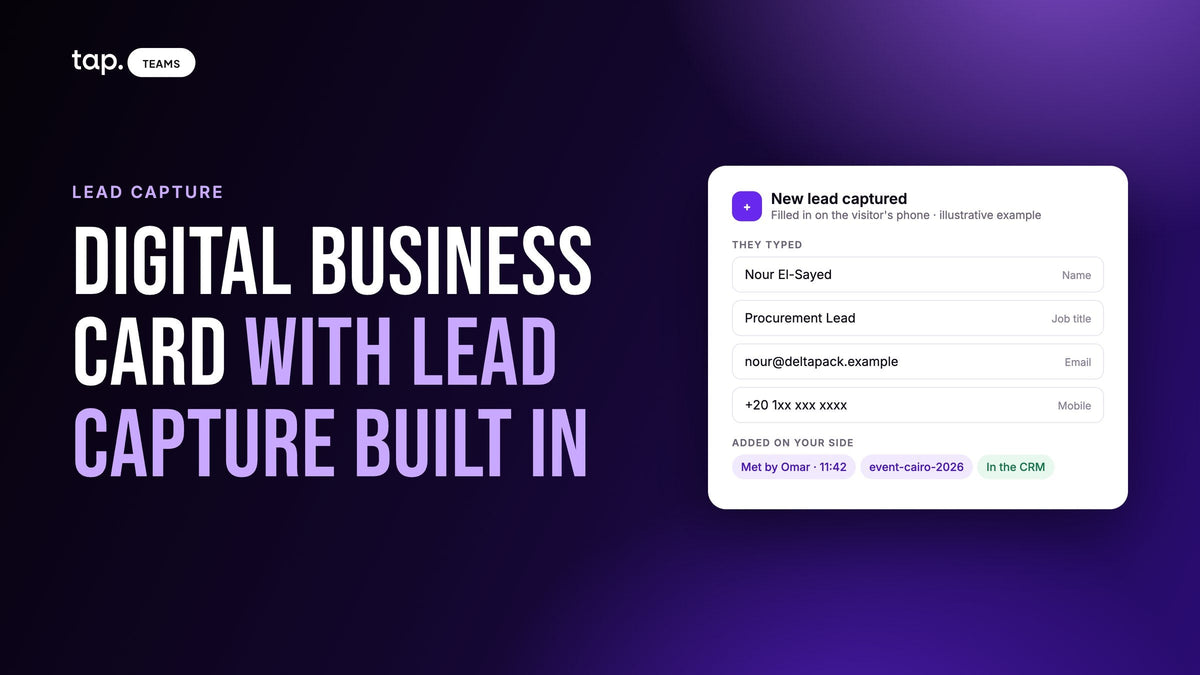
Tap is our product, so read this one with that in mind. Its docs describe it as a lead capture platform for teams who meet people in person: conferences, trade shows, field sales calls and events. The card or QR code starts the exchange and the visitor fills in your form on their own phone, so nothing is retyped. Reps can also scan business cards, QR codes and event badges, and Tap shows what it read before saving. From there, the product is about the lead more than the card. Every lead gets a quality score out of 100 from rules published in the docs. Enrichment fills only the empty fields, and a lookup that finds nothing costs nothing. The rep records the meeting that follows, and the analysis returns a summary, buying signals, objections, speaking time measured against a target for that meeting type, and sentiment. The summary and action items then sync to the lead's CRM record as a task.
Compared to Blinq, Tap lists fewer integrations and its docs don't describe identity provisioning, and Blinq's Notetaker captures in more ways (smartwatch, Bluetooth mic, phone calls). Where Tap goes further is what it does with a recording: Blinq's pages describe a transcript, a summary and next steps; Tap's docs describe buying signals, objections you can mark as handled, a talk ratio against a target, and a Team Insights view that rolls objections, sentiment trends and at-risk accounts up across every rep. Ask AI answers questions about a meeting with citations you can play back, and replies in Arabic when asked in Arabic. The app runs in English and Arabic.
Better fit when your reps sell face to face all year and a manager who wasn't in the room needs to know how the meeting went. Also the one on this list whose docs show native Veeva Vault and Odoo connectors, which matters for pharma and for companies that run on Odoo. See how Tap works for sales teams.
What to check: Tap's docs don't cover SSO or SCIM, Dynamics and Marketo aren't on the native list (Zapier reaches them), and there's no event budget or cost-per-lead model. Departments, templates, insights and CRM sync need a team plan. If an IT-led rollout to every employee is the job, Blinq, HiHello or Wave have more written down.
Blinq alternatives at a glance
| Tool | Fits best | Capture methods | Native CRMs listed | Team admin listed |
|---|---|---|---|---|
| Blinq | Free personal card; company-wide rollouts with IT involved; event campaigns | Badge, card, QR and LinkedIn scanning, offline; custom lead forms; AI Notetaker | HubSpot, Salesforce, Dynamics, GoHighLevel, Pipedrive, Zoho, monday.com, Marketo; Outlook; Zapier | SAML SSO, SCIM, template brand lock, admin-deployed signatures, subteam admins |
| Popl | Event marketing teams reporting pipeline by show | Universal badge scanner, cards, QR, forms, manual entry; offline; Event Flow qualifiers; AI Voice | Salesforce, HubSpot, Marketo, Dynamics, Zoho, Pipedrive, Pardot, monday.com; Slack | Bulk card management, SAML via Okta and Azure |
| HiHello | Marketing-led brand consistency across cards, signatures and backgrounds | Card, badge and QR scanning; custom lead forms; one-tap enrichment | Salesforce, HubSpot, Dynamics, Marketo; Leads or Contacts | SSO (OAuth, SAML/SCIM), HRIS provisioning, company directory |
| Mobilo | Sales teams wanting a team card plus ICP-based scoring | One-tap lead gen with custom questions; NFC, QR, manual; AI card scanning; offline | Salesforce, HubSpot, Pipedrive, Dynamics; Zapier; webhooks | Locked fields, SAML SSO, HRIS provisioning, roles, audit logs |
| Wave Connect | Card plus events plus signatures with a published credit model | AI badge scanner reading printed text; card scanning; offline; notes, tags and manual scores | Salesforce, HubSpot, Zoho, Pipedrive; Outlook; Dynamics on enterprise | Templates, locked content, SAML SSO, SCIM, sub-admins, custom domains |
| Uniqode | Teams already running QR campaigns; regulated industries | Badge and card scanning; two-way contact sharing; Wallet and Apple Watch | Built-in CRM, HubSpot, Salesforce; integrations on select plans | Locked templates, Okta and Entra ID provisioning, multi-org, SAML SSO |
| Tap | Field sales teams selling in person all year | Visitor's own form; card, QR and badge scanning with review; offline QR; meeting recording | Salesforce, HubSpot, Zoho, Pipedrive, Veeva Vault, Odoo; Zapier; Slack alerts | Templates, departments controlling fields and CRM access, sub-team admins |
The table uses only what each company publishes. Where a cell seems thin, ask the vendor; it may be a gap in the website rather than the product.

Which Blinq alternative should you pick?
If you mostly use Blinq's card, decide by rollout size. One person: honestly, stay on Blinq's free plan, or look at Wave's, which is also free for individuals. A whole company with IT in the room: HiHello or Wave, and pick between them on whether marketing or IT is driving. Blinq belongs on that shortlist too; its Notetaker and MCP are things the other two don't list.
If you mostly use Blinq at trade shows, look at Popl first. Its badge scanner, Event Flows and attribution reporting are built for a team that lives at shows. Wave is the lighter version of the same idea, and our Popl alternatives guide adds iCapture to that conversation.
If what you want is better leads after the handshake, the question changes from "which card" to "what happens to the lead." Mobilo scores by fit to your ideal customer. Tap scores from the captured data and the rep's buying-role answer, then adds the recorded conversation and a manager's view across the team. I'd run one real lead through both and see which record your sales manager would rather open on Monday morning. Whichever way you lean, our guide to digital business cards for teams covers the setup and control questions that apply to all of them.
How Tap handles this
Tap is built for the part that starts after the card is tapped. The visitor types their details into your lead capture form on their own phone, or the rep scans a card or badge and checks what was read. Every lead gets a quality score out of 100 from published rules, so the list sorts itself on the way home, and a rep marking someone a decision maker moves the score. Enrichment fills empty fields only and can be set to run automatically on leads above a score you choose, so credits go to the leads worth calling.
When there's a meeting, the rep records it with the other person's knowledge. Tap returns a summary, buying signals, objections, speaking time against a target for the meeting type, and sentiment, described in the meetings docs. Ask AI answers your own questions about the meeting and cites the moment in the recording. The lead then syncs to Salesforce, HubSpot, Zoho, Pipedrive, Veeva Vault or Odoo, owned by the CRM user whose email matches the rep, with the meeting summary and action items attached as a task; the integrations overview shows which record type each CRM creates. Existing records are merged, so blanks never erase data, Slack can post hot leads to a channel, and Team Insights shows managers the objections, sentiment trends and at-risk accounts across the whole team.
If that sounds like your team, see how Tap works for sales teams, or book a 30-minute demo and bring a meeting type your reps run every week.
FAQ
What is the best Blinq alternative?
It depends on which part of Blinq you use. For booth lead capture and pipeline by event, Popl. For marketing-led brand control, HiHello. For a team card with fit-based lead scoring, Mobilo. For the Blinq shape with a published credit model, Wave Connect. For QR campaigns and regulated industries, Uniqode. For field sales teams who need each lead scored, each meeting analyzed and both synced to the CRM under the rep, Tap. For a free personal card, Blinq itself is hard to beat.
Is there a free Blinq alternative?
For the card, yes. Wave Connect says it's free forever for individuals, HiHello starts individuals on a free trial, and Mobilo includes a digital card with any physical card or with its team plan. Tap has free plan features on every account, with departments, templates, insights and CRM sync on a team plan. Blinq's own free plan includes a card, virtual backgrounds and a personal email signature, so if a free card is all you need, there's no reason to switch.
Blinq vs Popl: which is better for events?
Both scan badges, enrich contacts, record conversations and report per event. Popl's whole site is organized around the event. Blinq's event capture is one part of a contact platform that also covers cards, signatures, Notetaker and MCP. A team that does a few shows a year and wants one tool leans Blinq; a team whose year is shows leans Popl.
Which Blinq alternative works without an app?
On the recipient's side, Blinq, Mobilo, Wave, Uniqode and Tap all say the visitor needs nothing installed; the card opens in their browser. For the person sharing, Wave's teams page says employees don't need to download an app to use their card, and Uniqode's comparison page makes the same point. Badge scanning and meeting recording are a separate question, so check what each vendor's page says the rep's phone needs.
Which Blinq alternatives have SSO and SCIM?
From their own pages: HiHello (OAuth 2.0 and SAML/SCIM, with Okta, Entra ID and Workday), Wave Connect (SAML SSO with Okta, Azure AD and Google, SCIM from Active Directory or Workday), Mobilo (SAML SSO and HRIS provisioning) and Uniqode (SAML SSO, Okta and Entra ID provisioning). Popl lists SAML login through Okta and Azure. Tap's docs don't cover SSO or SCIM; its access control runs through departments and templates instead.

Leave a comment
This site is protected by hCaptcha and the hCaptcha Privacy Policy and Terms of Service apply.