
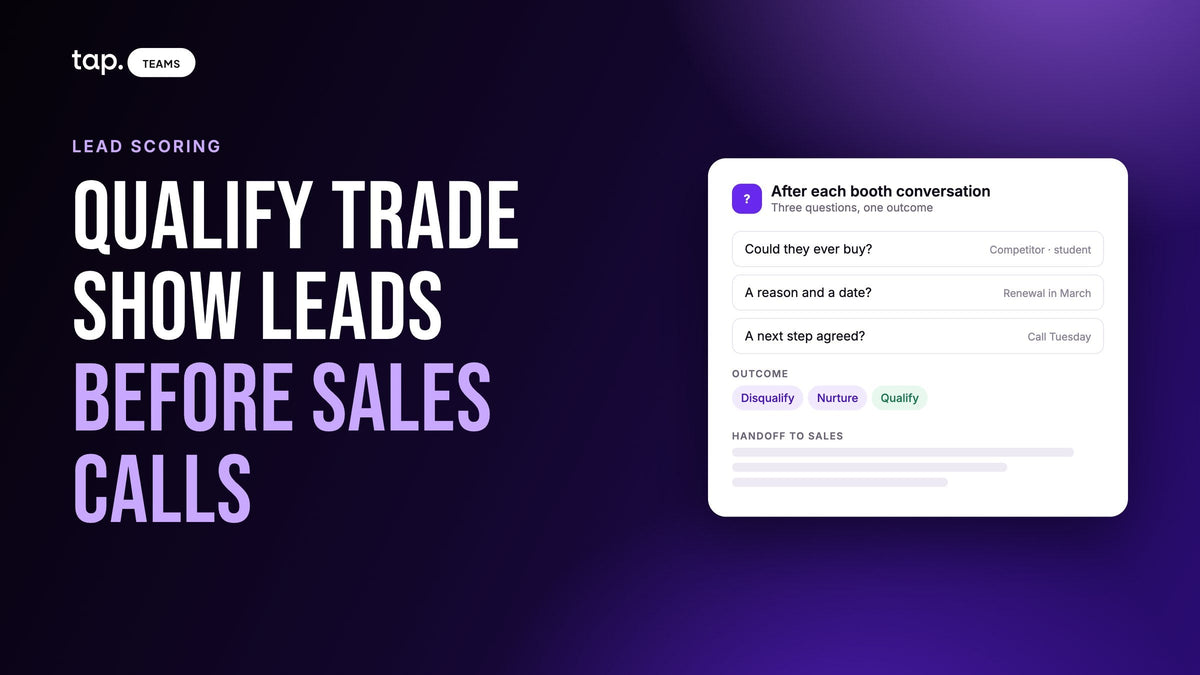
To qualify trade show leads before sales follows up, agree with sales what a qualified lead is before the show, ask three or four conversational questions at the booth, record the answers in the minute after each conversation, and sort every lead into qualify, nurture or disqualify that evening. Then hand each qualified lead to sales with a short note on what was said.
Most exhibitors do the first and last parts. They scan badges all day and send the list to sales on Monday. The middle is where qualification happens, and it's also where it falls apart: the questions don't get asked, the answers stay in the rep's head, and the salesperson who calls next week starts the conversation from zero. This guide covers that middle stretch, from the booth to the moment a lead lands with the person who will call it.
Two things it leaves to other guides. The order and timing of follow-up calls is in which trade show leads to call first, and when. A points-based scoresheet you can copy is in the lead scoring template.
What a qualified trade show lead is
Lead scoring and lead qualification get used as if they meant the same thing. They don't. A score ranks a list. Qualification is a yes or no decision about one person: is this someone sales should spend time on now? A score can feed that decision, and our guide to lead scoring for event and field leads covers how to build one. But at a trade show, a person makes the call, usually the one who had the conversation.
For an exhibitor, I'd call a lead qualified when four things are true:
- They fit the market you sell to: right kind of company, a region you can serve, a size you can handle.
- You can reach them, with a working email or phone number that belongs to them.
- They have a reason to talk to you again, in their words: a problem, a project, a deadline.
- They agreed to something next, even if it's small. A call next week. A quote. An introduction to their boss.
The fourth one is the test most booths skip. Someone who fits perfectly but agreed to nothing is a nurture lead, however good they looked. Someone who agreed to a call is qualified even if their title is modest, because the call is the next step and you already have it.
Agree the definition with sales before the show
Qualification fails most often because booth staff and sales mean different things by "good lead." Marketing counts every conversation. Sales wants buyers. If nobody writes the definition down, the booth qualifies on enthusiasm and sales ignores the list.
A week before the show, sit down with whoever will follow up and agree on three short lists:
- What makes a lead qualified, using the four tests above, adjusted to your market.
- Who never counts: competitors, other exhibitors selling to you, students, job seekers, companies outside your territory.
- What sales needs to know before calling. That list becomes the handoff note later on.
Keep it to one page and give a printed copy to everyone working the booth. If the stand is staffed by people who don't sell, such as product specialists, marketing or agency staff, this page matters even more, because they can't fall back on instinct.
Questions to ask at the booth
The classic frame is BANT: budget, authority, need, timing. It's a reasonable checklist for what you want to learn. It's a poor script. Ask a stranger at a booth "do you have budget?" and they'll walk away or say yes to be polite. Neither tells you anything.
Ask about their situation instead, and let the qualifying answers come out of it. Each question below earns one signal you can write down.

Start with the problem
"What brought you to the show?" or "What are you working on this year?" Both are easy to answer and both tell you whether there's a need. A vague answer ("just looking around") is a signal too. If they mention a specific problem, ask what they're using for it today. That tells you whether you'd be replacing someone, and replacing an incumbent is a different sale from filling a gap.
Place their role without asking for it
"Are you the decision maker?" gets you a yes from almost everyone. "Who else would be involved if you changed this?" or "How did your team pick the last tool you bought?" gets you the real shape of the decision. You'll hear whether they sign, recommend, use the thing or screen vendors for someone else. Our piece on buying roles in B2B sales has more questions like these.
Find the clock
"Is there a date this needs to be sorted by?" A contract renewal, a new site opening, a budget year ending. A named date is the strongest timing signal you'll get at a booth. "Sometime next year" is useful too: it tells you this is a nurture lead, and you can stop pitching.
Ask for the next step
"Would it help if someone walked you through this properly next week?" This is the question that turns a pleasant conversation into a qualified lead. If they say yes, agree on a day while they're standing there. If they say "send me something," that's a softer yes. Write down exactly what they asked for.
Budget usually comes out of the problem and the clock. If someone is replacing a system before a renewal date, money exists. If it doesn't come up, leave it for the sales call. You'll lose more good leads by asking about money at a booth than you'll save.
What to record in the minute after
The conversation ends, the person walks away, and the next visitor is already there. You have about a minute to get down what you learned, and if you skip it, it's gone. By the evening you won't remember which of the twelve operations managers mentioned the renewal date.
Record signals, not a transcript. Two or three words each is enough:
- Their role in the decision: signs, recommends, uses, screens.
- New business, or an existing customer.
- The problem, in their words. "Reps losing cards at shows" beats "interested in lead capture."
- Any date they mentioned.
- Who else is involved, by name or title if you got it.
- What you promised and what they agreed to.
Write it where the lead lives, in the lead capture app or on the record itself. A scribble on the back of a business card has to be typed up later, which means it mostly doesn't get typed up. A voice note works well if your tool keeps it attached to the lead; it's quicker than typing when the booth is busy.
Don't trust the badge for any of this. A registration job title is whatever the attendee typed months ago, and it says nothing about their role in your deal. When the badge says "Manager" and the conversation says they sign off on the budget, the conversation wins.
Qualify, nurture or disqualify
Every lead should leave the show with one of three labels. A lot of teams use hot, warm and cold, and that works for ranking, but at this stage the question is simpler: what happens to this person next?

Qualify when they fit, you can reach them, and they agreed to a next step. These go to sales with a note, and sales calls them.
Nurture when they fit but nothing is happening yet: no date, no next step, or the right company and the wrong person. These go into a marketing sequence, and someone checks back in a few months.
Disqualify when they aren't a buyer at all. That covers competitors checking your demo, other exhibitors pitching you, students, job seekers, and anyone from a company or region you can't sell to.
"Good fit, wrong person" isn't a disqualification
The influencer from a perfect account is one of the most useful people you'll meet at a show. They can't sign, but they can tell you who does and walk you in. Nurture them, and ask them for the introduction in your first follow-up. The same goes for existing customers: they aren't new leads, but they shouldn't vanish either. Route them to whoever owns the account.
Disqualify with a reason, don't delete
Deleting non-buyers feels tidy. It costs you twice. First, your event numbers stop adding up, because the leads you captured and the leads you report no longer match. Second, someone will rescan the same competitor next year and nobody will know. Mark them with a reason (competitor, student, vendor, outside territory) and keep them out of sales queues and email sequences.
The hours after the booth closes
The evening of each show day is when qualification gets finished. It takes the booth team twenty or thirty minutes, and it's worth more than anything else they do after hours.
Each rep goes through the day's leads and fills in what they skipped while the booth was busy. Anything still blank gets a best answer now, while there's still a face to attach to the name. Then each lead gets its qualify, nurture or disqualify label.
If a manager is at the show, they spend ten minutes spot-checking. Two patterns are worth catching on day one rather than after the show. A rep who qualified nearly everyone is labeling on friendliness, not on the four tests. A rep with most fields blank is too busy to record, and probably needs a second person at the booth during peak hours.
Finally, tag the day's leads with the show name, all at once, rather than asking each visitor which event they're at. Which leads get called first, and when, is a separate decision; the trade show follow-up guide linked above covers that order day by day.
Handing the lead to sales with context
Here is the failure most exhibitors know. The lead reaches a salesperson as a name, a company and an email. The salesperson calls, says "thanks for stopping by our booth," and asks the same questions the booth rep asked four days earlier. The buyer, who explained their whole situation once, now has to do it again for someone who clearly didn't listen. Some do. Plenty don't pick up the second time.
If that's what happens to your show leads, you can see how Tap keeps the booth notes on the lead in a 30-minute demo.
The fix is a short handoff note on every qualified lead. Not a report, just enough that the first call picks up where the booth left off.

A good note answers six questions: who they are in the decision, why they stopped, what they're using now, the date that matters, who else is involved, and what was promised or agreed. The salesperson reads it in thirty seconds and opens with "You mentioned your renewal in March" instead of "Thanks for stopping by."
Two rules make handoffs stick. Each qualified lead has one named owner, so nobody assumes someone else called. And the note travels inside the CRM record, not in an email or a chat thread the salesperson has to go looking for.
Where trade show lead qualification goes wrong
Qualifying on the badge. Job titles from registration are the easiest data to sort by and the least reliable. Use them for fit, never for role.
Turning the booth into an interview. Visitors who feel interrogated give short answers or leave. Three or four natural questions beat a full checklist, and anything you don't learn at the booth can wait for the call.
Calling everyone qualified. If most of the show's leads end up in the qualify pile, the definition is too loose, and sales will treat the whole list as noise. A short qualified list that sales trusts is worth more than a long one they ignore.
Leaving it in the rep's head. Qualification that isn't written on the lead didn't happen, as far as the person calling is concerned.
Qualifying once and never again. A nurture lead from March may be ready by September. Somebody should look at the nurture list after each quarter and move the ones whose situation changed.
How Tap handles this
Right after a lead is saved, the Tap app offers two quick questions: the relationship (how you know them) and their buying role. Both can be skipped at a busy booth and filled in that evening. Relationship is for sorting and never changes the score. Buying role does: decision maker adds 25 points, influencer 15, end user 8 and gatekeeper 5, and marking a lead "Not relevant" caps its score at 25, which keeps students and competitors in the Cold tier.
Every lead gets a quality score out of 100, calculated from the data captured. Hot is 75 to 100 and worth a same-day call, Warm is 40 to 74 for a follow-up sequence, and Cold is 0 to 39, to nurture or leave alone. The score can't hear the conversation, though, so read it alongside the notes rather than instead of them. The lead quality score docs have the full rules.
For the handoff, notes attach to the lead: typed in the app or the dashboard, or recorded as a voice note that is transcribed and summarized. If Sync Notes is on for your CRM connection, the notes travel with the lead. Salesforce, Zoho and Pipedrive receive it as a Lead rather than a Contact, so it waits for your normal qualification process. Tags such as not-a-fit mark a disqualified lead without deleting it, and a manager can select a show's leads and tag them together. On Team Insights, the Lead quality cards show how many leads have their buying role and relationship answered, and how many the reps skipped.
To see how your next show's leads would come back, look at Tap lead capture.
FAQ
Who can help qualify trade show leads before sales follows up?
Usually the booth staff themselves, with a lead capture app that lets them answer a few qualifying questions and add a note right after each conversation. Some teams add an inside sales rep who reviews the list each evening, and some hire trained booth staff from an agency. Whoever does it needs a written definition of a qualified lead, agreed with sales before the show, and a lead capture tool that keeps the answers on the lead.
What questions should you ask to qualify a lead at a trade show?
Ask what brought them to the show, what they use today, who else would be involved in a change, whether there's a date it needs to happen by, and whether a proper walkthrough next week would help. Those cover need, role, timing and the next step without sounding like a checklist. Leave budget for the sales call unless they raise it.
How do you disqualify a trade show lead?
Mark it with a reason (competitor, student, job seeker, vendor, outside your territory) and keep it out of sales queues and email sequences. Don't delete it. Keeping it means your event numbers still add up and the same person doesn't get qualified again next year.
What is the difference between lead scoring and lead qualification?
Lead scoring ranks a list of leads by points. Lead qualification is the decision about one lead: pass it to sales, nurture it, or drop it. A score can inform that decision, but at a trade show the person who had the conversation usually knows things the score can't see.
When should trade show leads be qualified?
At the booth, in the minute after each conversation, and then again that evening, when each rep fills in what they skipped and labels every lead qualify, nurture or disqualify. Waiting until after the show means qualifying from memory, and memory of forty conversations is mostly guesswork.

Leave a comment
This site is protected by hCaptcha and the hCaptcha Privacy Policy and Terms of Service apply.