
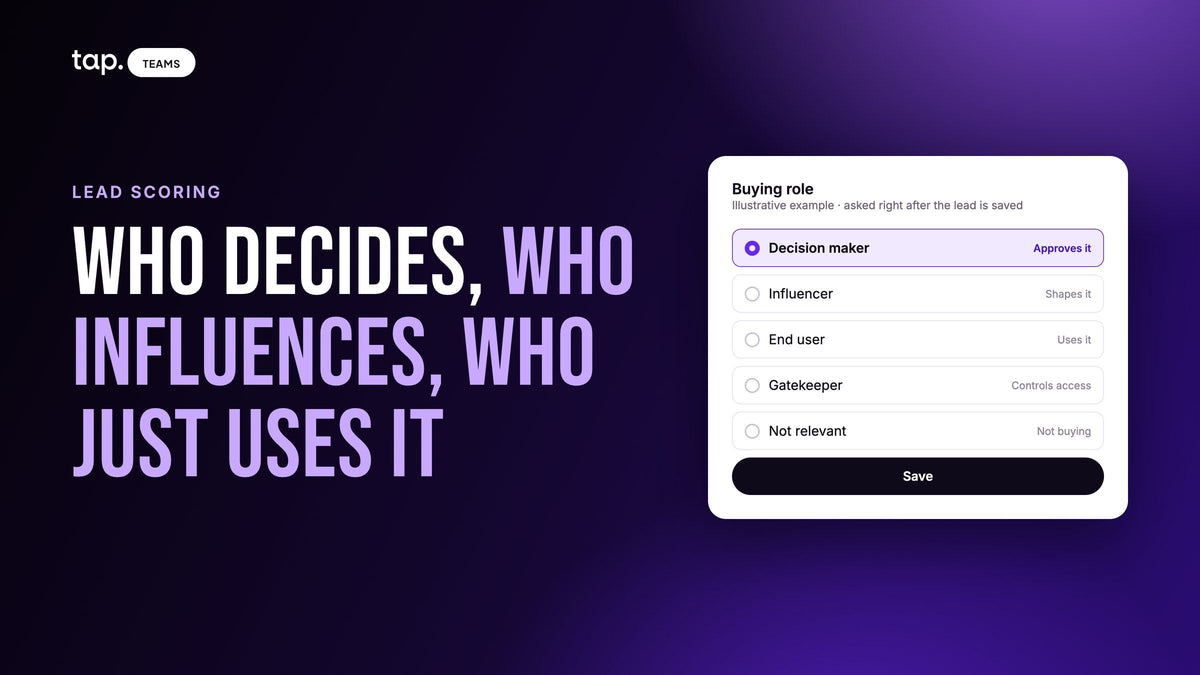
B2B buying roles describe the part each person plays in a purchase. The decision maker approves it, the influencer shapes it, the end user lives with the result, and the gatekeeper controls access to the people who decide. Some people you meet play no part at all. Knowing which role you're talking to tells you what to do next.
Most guides to buying roles assume you'll research the account on LinkedIn before you ever speak to anyone. Field sales reps don't get that luxury. You meet people at a stand, in a client's site office or between sessions at a congress, you have a few minutes, and nobody hands you an org chart. This guide covers what each role is, how to recognize it in person, what to ask, and who to follow up with afterward.
The four buying roles
Purchases inside a company are made by a group, sometimes called the buying center, and each person in it has a different job in the decision. Labels vary, but four roles show up in nearly every version.
Decision maker
The person who can say yes and make it stick. They approve the spend, or they're the one whose approval everyone else is waiting for. In a small company that's often the owner. In a large one it might be a department head with a budget, and it's often not the most senior person you meet. For a field rep, the practical question is simple: whose yes ends the discussion?
Influencer
Someone whose opinion shapes the decision without making it. Engineers who write the specification, a head of IT who has to sign off on security, a senior clinician whose view the purchasing committee trusts. Influencers often do the comparison work, which is why they're the ones asking detailed questions at your stand. A "champion," in the vendor literature, is an influencer who has decided they want you to win.
End user
The people who'll use what gets bought, every day. They feel the problem most directly and can describe it better than anyone. They usually can't approve a purchase, but they can sink one.
Gatekeeper
The person who controls access to the others. An executive assistant, a receptionist, a procurement officer who decides which suppliers get on the list, a coordinator who manages the diary of the people you need. They're often the fastest route to the right person, if you treat them as someone with a job to do.
Some frameworks add a buyer (procurement) and an initiator (whoever first raised the need), and vendor guides add champions and economic buyers. For tagging the person in front of you, the four roles above cover almost everyone, plus one more answer you'll need more often than you'd think: not relevant.
| Role | What they control | What it sounds like in person | A question that confirms it |
|---|---|---|---|
| Decision maker | The yes, and usually the budget | "We," "our plan," talk of cost and timing; few product details | "If this made sense, what would it take to get it approved?" |
| Influencer | The shortlist and the requirements | Detailed technical or clinical questions; "I'd have to take this back to..." | "Who else would want to see this before anything moves?" |
| End user | Whether it gets used | The problem in vivid detail; "every morning we have to..." | "How do you handle that today?" |
| Gatekeeper | Access to the others | Collects material "for my manager"; asks you to send things through them | "Who's the best person to talk to about this, and how do they like to be approached?" |
Why a buying role beats a job title
It's tempting to read the role off the badge, but titles mislead in both directions. Take three people with the same title, operations manager. At a 40-person distributor, the operations manager may run the whole warehouse and sign off on anything under a certain amount without asking anyone. At a multinational, the operations manager at one plant may only be allowed to recommend, while a regional director decides. And at a third company, the operations manager may be the person who'll use your system every shift and has no say in buying it at all.

The reverse happens too: a "senior specialist" at a hospital might chair the committee that picks the supplier. A title tells you roughly where someone sits. A role tells you what they can do for the deal, and that's what decides who gets the next call.
How to recognize each role face to face
In person you can see how people behave, which no LinkedIn search shows. At a trade show booth, decision makers tend to ask fewer and broader questions. They want to know whether you can do it and roughly what it involves. Influencers ask for the spec sheet, then ask about the one thing on it that worries them. End users ask how it works in practice ("what happens when the connection drops?"). Gatekeepers often collect material for someone else and say so.
On a site visit, watch who the others look at before answering. When the plant manager waits for the engineer to nod, the engineer is more than an end user. And notice who brings up cost. Usually only people near the budget do.
At a congress or conference, the role often shows in why they're there. A clinician presenting a paper is likely an influencer for their department. A procurement lead walking the exhibition with a list is a buyer, and usually a gatekeeper to the clinicians. Someone who stops because of a specific problem their unit has is often an end user, and sometimes a very good way in.
Questions that place someone without asking "are you the decision maker?"
"Are you the decision maker?" is the worst way to find out. Almost everyone says yes, or feels slighted, and you learn nothing. Questions about how their company buys work better, because people answer them honestly and the role falls out of the answer.
- "How do decisions like this usually get made at your company?"
- "Who else would be involved if you wanted to change how you do this?"
- "Last time you brought in a new supplier for something like this, how did it go?"
- "What would you need to see to take this further internally?"
- "Is this something you'd use yourself, or something your team would use?"
- "Who'd be the right person for me to follow up with?"
Listen for "I" versus "we" and "they." Someone who says "I'd need to see the numbers" is closer to the decision than someone who says "they'd want to see the numbers." When somebody names another person ("you'd need to talk to our procurement manager"), write the name down. You've just learned the role of two people.
Pay attention to timing and problem words too. Those are buying signals, a separate thing from the role, and our guide to buying signals in a sales conversation covers them. A decision maker with no problem and no timeline is a lower priority than an influencer with both.
What to do next for each role
The role decides what the follow-up is for.
A decision maker gets the first call, from the rep who met them, ideally the same day or the next morning. The goal is a meeting. Open with whatever they said at the stand, keep it short, and don't send a deck they didn't ask for.
An influencer needs material they can carry into a room you won't be in. That might be the spec they asked about or an answer to their one worry. Then ask the question that matters: who decides, and would they introduce you? A good influencer is often the best route to a decision maker you never met.
An end user is where you learn the problem properly. Follow up with questions and leave the pitch for later. Ask how the current process works, what goes wrong and who else feels it. Then ask who'd be involved in changing it.
A gatekeeper should get exactly what they asked for, quickly, plus a clear ask: the right name, and how that person likes to be approached.

When you meet several people from one company
Buying groups come to you too. Three people from the same hospital stop at the stand together. A site visit includes the plant manager, a maintenance engineer and someone from finance who joins for the last twenty minutes. Each is a separate lead with a separate role, and the mistake is to capture one of them (usually the most senior-looking) and lose the rest.
Tag each person with their own role while you still remember who said what. Put them in the same group or tag them with the account, so whoever follows up sees them together. Then decide who leads. Usually the rep calls the decision maker and sends the influencer the material they asked for, and the end user hears back with questions. Two reps calling two people at the same company with two different stories is how deals stall before they start.
Roles also change. The influencer you met in March is promoted in June and now owns the budget. Update the role after each follow-up conversation.
The "not relevant" case
Every stand gets visitors who aren't part of any purchase. Students collecting free pens. Job seekers. A competitor's rep having a look. Suppliers who want to sell to you. If they go into the same list as everyone else, they cost time twice: once when someone calls them, and again when they distort every report on the event.
Mark them as not relevant on the spot. Nobody is judging the person. The tag keeps the follow-up list honest, so the manager's count of "leads from the show" means people who could buy. If whatever you capture leads with has no "not relevant" option, add one.
Where buying roles fit in a lead score
A score built only from what's on the record can't tell a director who said "we're choosing next month" from one who took a pen. The buying role is how the conversation gets into the score, and "not relevant" should keep a lead out of the hot tier. The full approach is in our guide to lead scoring for event and field leads, there's a 100-point model with every weight if you're building your own, and hot, warm and cold leads covers what each score band means for the follow-up.
How Tap handles this
In Tap, the buying role is asked for at capture. Right after a lead is saved, the mobile app offers two quick questions: relationship (how you know them) and buying role (decision maker, influencer, end user, gatekeeper or not relevant). Both can be skipped in the moment and filled in later, though the docs suggest answering at the event: thirty seconds while the conversation is fresh beats guessing a fortnight later.
Relationship is for sorting only and never changes the score. Buying role does. Every lead gets a quality score out of 100, calculated from the data captured, and the buying role takes over the 25-point seniority slot: a decision maker adds 25, an influencer 15, an end user 8 and a gatekeeper 5. Without a buying role, that slot falls back to seniority from lead enrichment, then to the job title. "Not relevant" scores nothing there and caps the whole lead at 25, which keeps it in the Cold band (0 to 39) however complete the record is. The lead quality score docs have the full rules.
Managers see the result on Team Insights: how many decision makers the team met, the split across influencers, end users, gatekeepers and leads marked not relevant, and how many leads were qualified out of the total, with skipped questions counted as skipped. The Team Insights docs explain each card. In Tap Teams, each lead's page shows the relationship and buying role next to everything captured, and the lead can be reassigned or tagged from there.
If your reps meet buyers in person, see how Tap for field sales works, or book a 30-minute demo.
FAQ
What are the buying roles in B2B sales?
The four most used are decision maker, influencer, end user and gatekeeper. Some frameworks add a buyer, who handles procurement and terms, and an initiator, who first raised the need. In practice you also need a way to mark people who aren't part of any purchase at all.
What is the difference between a decision maker and an influencer?
A decision maker can approve the purchase. An influencer shapes it, by writing the requirements, comparing suppliers or advising the person who decides, but can't say the final yes. Influencers are often the people asking the most detailed questions, which makes them easy to mistake for the buyer.
Can one person have more than one buying role?
Yes, especially in smaller companies, where an owner may decide, influence and use the product all at once. When you tag a lead, pick the role that best describes what they can do for the next step, usually the one with the most authority.
How do you know if you're talking to the real decision maker?
Ask how decisions like this get made at their company and who else would be involved, rather than asking whether they decide. Listen for "I" versus "they," and for who brings up budget and timing. If they name someone else, you've found both roles.
What is a buying center?
The group of people inside a company who take part in a purchase decision. The term comes from business-marketing research, and it's also called a buying committee or buying group. Its size and makeup vary with the company and the size of the purchase, so map each account on its own.

Leave a comment
This site is protected by hCaptcha and the hCaptcha Privacy Policy and Terms of Service apply.