
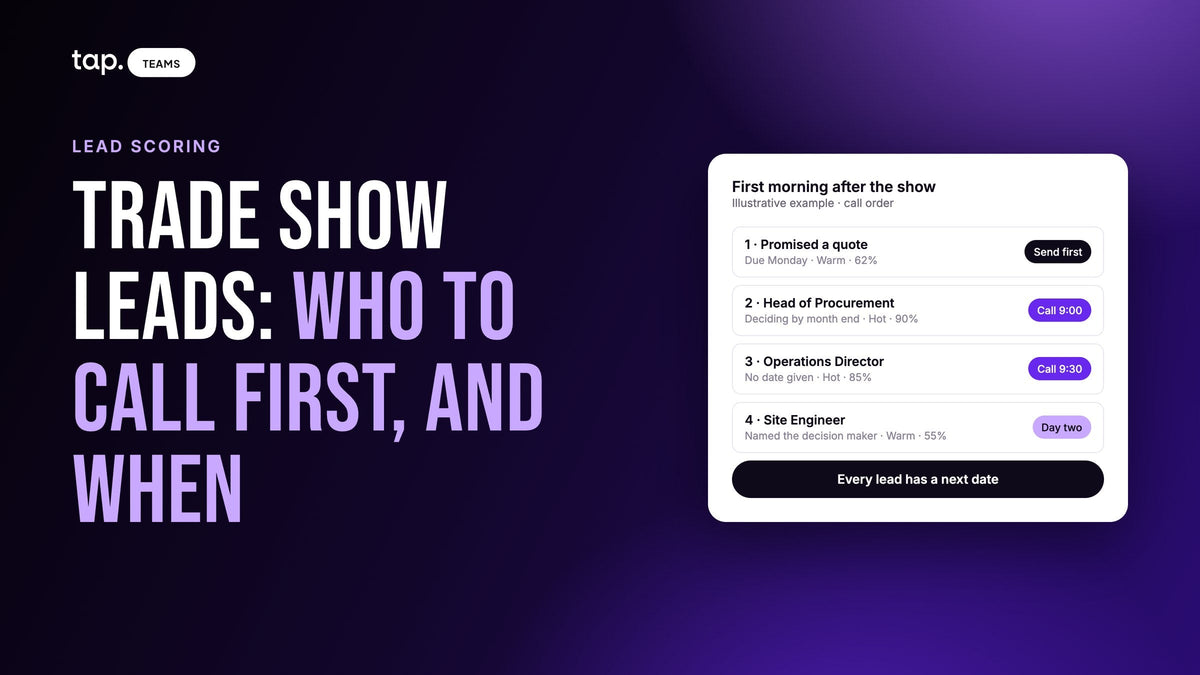
After a trade show, call leads in this order: anyone you promised something to, then hot leads who named a deadline, then other hot leads, then warm influencers who can introduce you to a decision maker. Make the first calls within one working day of the show closing, start the warm sequence that week, and send cold leads one email.
Most advice on trade show lead follow-up stops at "be fast and sort them hot, warm and cold." That's true, and it isn't enough. A team that comes back with 150 leads still has to decide which of the 25 hot ones gets the 9 a.m. call, what happens while two reps are still on a plane, and how to stop the leads from vanishing somewhere between the badge scanner and the first email. This guide is about that part: the order and the timing.
The follow-up order, from first to last
A lead score gets the list roughly sorted. If you don't have one yet, our guide to lead scoring for event and field leads covers how to build it, and the hot, warm and cold leads piece covers what each tier means. The score is a sort on who the person is, though. It doesn't know what was said, so the order below starts with the things a score can't see.
| Order | Who | First touch | When |
|---|---|---|---|
| 1 | Anyone you promised something to: a quote, a sample, a demo slot, an introduction | Deliver the thing, with a short note | Before anything else, ideally the day you promised it |
| 2 | Hot leads who named a date or a deadline | A call from the rep who met them | First working morning after the show, or during it |
| 3 | Other hot leads | A call, then an email that recaps it | Within one working day of the show closing |
| 4 | Existing customers who stopped by | A message from their account owner | The same week |
| 5 | Warm leads who named the person who decides | A call asking for the introduction | Once the hot calls are done, usually days two and three |
| 6 | Other warm leads | The first email in a short sequence | By the end of the first week |
| 7 | Cold leads | One specific email, then nurture | By the end of the first week |
Two of those rows are worth explaining.
Why promises go first, whatever the score
A promise is the only lead where the other person is actively waiting for you. Say a procurement manager asked for a price on a specific configuration and your rep said "I'll have it to you Monday." That lead might score warm, because she gave a personal email and skipped her job title. It doesn't matter. On Monday she's either looking at your quote or noticing that you didn't send one, and the second outcome costs you more than a slow call to a hot lead ever would.
So keep promises as their own list, separate from the score. The simplest version is a line in the lead's notes that starts with "Promised:" and a date, written at the stand or that evening. Before anyone starts calling on the first morning, someone goes through that list and checks every item has an owner and a send date.
Existing customers aren't new leads
The customer who dropped by to say hello will often score high: full details, company email, senior title. Put them in the hot queue and a rep who has never spoken to them cold-calls an account someone else manages. Route them to their account owner instead, with a note on what they asked about. That's often an upsell or a renewal conversation, and it belongs to whoever already has the relationship.

How to break ties inside the hot tier
Say a four-person team has 25 hot leads and each rep can make six or seven good calls before lunch. The score will happily show several leads at the same level, and the order among them still matters, because the last call of the morning lands a day later than the first. When the score can't separate two leads, these can.
- A stated date. "We're choosing a supplier by the end of the month" beats "we're reviewing options." Someone with a deadline is the one most likely to go with whoever calls first.
- They mentioned other suppliers at the show. If they said they're also talking to the stand across the aisle, they'll be getting calls this week. Get there before the comparison hardens.
- Their time zone. At an international show, visitors fly home to different working days. A lead from a market whose week ends on Thursday, or whose office closes six hours before yours, needs the early slot, or your first call waits until next week.
- They're about to be unreachable. "I'm off on leave from the 20th" means call on the 19th or wait three weeks.
- An open deal already exists at their company. A good conversation with a new contact at an account in the pipeline can move a deal that's already worth something.
None of this needs a model. It needs the rep to write one line on the lead before they forget it, which is why the evening of each show day matters so much.
The follow-up timeline, day by day
Here's one way the month after a show can run. Treat the days as a template to adjust, not a rule; the point is that every tier has a date attached before the show ends.
Each evening of the show
Twenty minutes, before dinner. Each rep fills in whatever they skipped during the day (buying role, a line of notes, any promise and its date) and photographs or scans any business cards. Then they look at today's hot leads and send each one a short email that same night: "Good to meet you at the stand today. I'll call on Monday about the second site, as we discussed." It takes a minute, and it puts your name in their inbox before the suppliers who wait until next week.
On a four-day show, this matters most on day one. A hot lead from Tuesday morning who hears nothing until the following Monday has had six days to forget you.
The day the show closes
Pack-down day is usually lost to logistics, and the travel day after it is lost to airports. The manager can use that time. Pull the full list, check that every lead from every rep has arrived in the CRM, tag the lot with the event name, and split the hot tier by who met whom. If a rep's leads are missing, find out now, while the rep still has the phone in their pocket.
The first working day back
Promises out first, then hot calls, starting with the leads that named a date. Every call opens with something specific from the stand ("you said the current system can't handle the second warehouse") and ends with a dated next step. After each call, the rep updates the lead before dialing the next number: what changed, and when the next touch is.
Days two and three
Finish any hot calls that didn't connect, and leave a voicemail plus a short email for each. Then call the warm leads who named a decision maker and ask for the introduction. Start the warm email sequence for the rest, with the first email mentioning the show and one thing from the conversation.
The end of week one
Hot leads you haven't reached get a second call attempt at a different time of day. Cold leads get their one email: the stand, the date, and the one thing you'd have told them if they'd stopped for longer. Existing customers should all have heard from their account owner by now.
Weeks two to four
The warm sequence carries on, two or three emails in total, each adding something useful (a short case example, an answer to a question they asked) instead of "just checking in." A warm lead who replies gets a call within the day and is treated as hot. A hot lead who still hasn't answered after three or four attempts across two weeks moves to the warm sequence. You don't drop them. They just stop taking a morning call slot from someone who will pick up.
Around day 30, anyone who hasn't engaged goes to longer-term nurture, tagged with the event, so the rep knows next year that this person has been in the room before.

When reps are still traveling
The common complaint from field reps is that follow-up takes days, because there's a stack of cards to type in and a flight in between. Two changes fix most of it.
First, split the work by what needs the rep. Only the rep can make the hot calls well, because only the rep can say "you mentioned the March deadline." Everything else (checking that leads arrived, tagging, starting the warm sequence, routing existing customers) can be done by a manager or an inside sales colleague from the office while the rep is in the air. The rep's job on the travel day is to have their notes on the leads, so whoever starts the sequence isn't sending a generic email.
Second, don't let the stack of business cards wait for the office. Sort the stack the same evening into three piles: promises and hot, warm, and everything else. Then scan the first pile first. Scanning in the order you met people preserves the order of the day, not the order of importance, and a card at the bottom of the pile is a lead that gets entered last and called last. Our article on business card scanners and what reaches your CRM covers what a scan gets right and what to check before you save.
Better still is not having the stack at all. Leads captured on a form at the stand, the way Tap's lead capture works, arrive with the details typed by the visitor and already in the list, so the rep's evening goes on notes instead of data entry. Our guide to trade show lead capture covers that side.
Where trade show leads fall into a black hole
Leads rarely disappear in one dramatic failure. They get lost in the gaps between people and systems, usually because two steps happen in the wrong order.
The spreadsheet waits for the upload
The badge scanner export, or a shared sheet of typed-up cards, sits in someone's inbox until marketing has time to clean and import it. That's often a week. Every lead on it is a week colder before any system knows it exists. If your capture doesn't put leads straight into the CRM, set a deadline for the import (the first working day back, not "when we get to it") and give it to one person.
The bulk email beats the rep's call
Marketing imports the full list on day one and the "thanks for visiting our stand" email goes to all 150. The hot lead the rep planned to call that afternoon now has a generic email from the company, followed two hours later by a rep acting as if they're getting in touch for the first time. It reads as disorganized because it is. Hold the hot tier out of any bulk send until the rep has called, or let the rep's own email be the first thing the lead sees.
Replies land in the wrong inbox
A warm lead replies to the sequence email with "yes, can we talk next week?", and the reply goes to a shared marketing address or a no-reply mailbox. Nobody tells the rep. Whatever sends the sequence, make sure replies reach the person who met the lead, and that a reply moves the lead into the call queue.
Nobody owns the leftovers
Hot leads have an owner because everyone knows they matter. The warm lead who didn't answer twice, the cold scan that turned out to be a director: those drift. The pillar's section on thresholds and the handoff to sales covers ownership and deadlines per tier. For timing, the rule I'd add is simple: no lead leaves the first week without a next date on it, even if that date is "nurture, day 30."
What to say in the first follow-up
Short, specific, one ask. The opening line names something from the conversation that only the two of you know about. The middle line is the thing you promised, or the reason to talk. The last line is a single next step with a time attached.
A hypothetical example for a hot lead: "Good to meet you at the stand on Tuesday. You mentioned the second warehouse opens in March and the current system can't handle two sites. I've attached the two-site setup we talked about. Could we do 20 minutes on Thursday at 10 to go through it?"
Leave out the company history and the full deck. If they want more, they'll ask, and then you have a reply instead of a read receipt.
How Tap handles this
Tap gives every captured lead a quality score out of 100, calculated from the data captured. In Tap Teams it shows as a percentage so a manager can sort the whole show's leads and work from the top, and the leads list shows each lead's score, who on the team met them and exactly when. In the mobile app the same score is a Hot, Warm or Cold badge: Hot is 75 to 100 and worth a same-day call, Warm is 40 to 74 for a follow-up sequence, and Cold is 0 to 39, to nurture or leave alone. The buying role can be skipped at a busy stand and filled in that evening. The lead quality score docs have the full rules.
For the day the show closes, a manager can filter the leads list to the show's dates, select them all and tag them in one action, then reassign or email a selection together. If you use Slack, the Hot lead alert posts every lead scoring 80 or higher to a channel you pick; like every Slack event, it starts off until an admin turns it on.
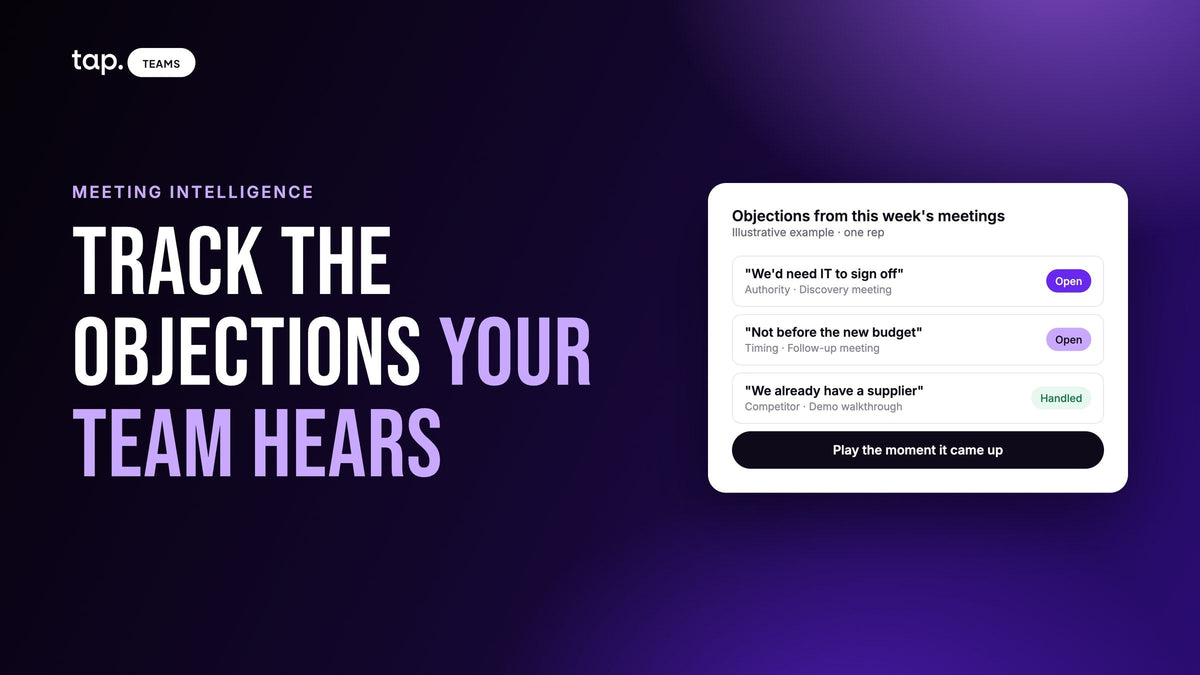
For promises, a task on a lead's note can carry a due date and a reminder that pushes to the rep's phone when it's due. Commitments made in a recorded meeting become follow-ups automatically and sync to your CRM as tasks, and action completion in Team Insights shows, rep by rep, who is closing loops and who is collecting open promises. The follow-ups docs cover that side.
For the stack of cards, the app scans a business card, or a photo of one you took earlier from the gallery, and shows what it read before you save. A scanned lead scores and syncs like one captured on a form, and leads captured offline appear once the phone reconnects.
To see how your last show's leads would sort, look at Tap lead capture or book a 30-minute demo.
FAQ
How soon should you follow up after a trade show?
Hot leads within one working day of the show closing, and ideally a short email the same evening you met them. Warm leads within the first week. Cold leads by the end of the first week. If you're traveling, send the hot emails from the hotel and let a colleague start the warm sequence from the office.
How do you prioritize trade show leads?
Sort by lead score first, then move promises to the very top and break ties inside the hot tier by stated deadlines, competing suppliers and time zones. Route existing customers to their account owners instead of the hot queue. Everyone else follows their tier's timeline.
How many times should you follow up with a trade show lead?
Three or four call attempts over two weeks for hot leads, two or three emails over about a month for warm leads, and one email for cold leads before they go to nurture. Each touch should add something new. A lead who replies at any point moves up to a call.
What should a trade show follow-up email say?
Name something specific from your conversation in the first line, deliver anything you promised, and end with one next step and a time. Keep it to a few sentences. Leave the brochure out unless they asked for it.
How do I follow up faster when I have a stack of business cards to enter?
Sort the stack the same evening into hot, warm and the rest, and scan the hot pile first so the most important leads are in your CRM before you fly home. Send the hot leads a short email that night. Better still, capture leads on a form at the stand so there's no stack to type up.

Leave a comment
This site is protected by hCaptcha and the hCaptcha Privacy Policy and Terms of Service apply.