
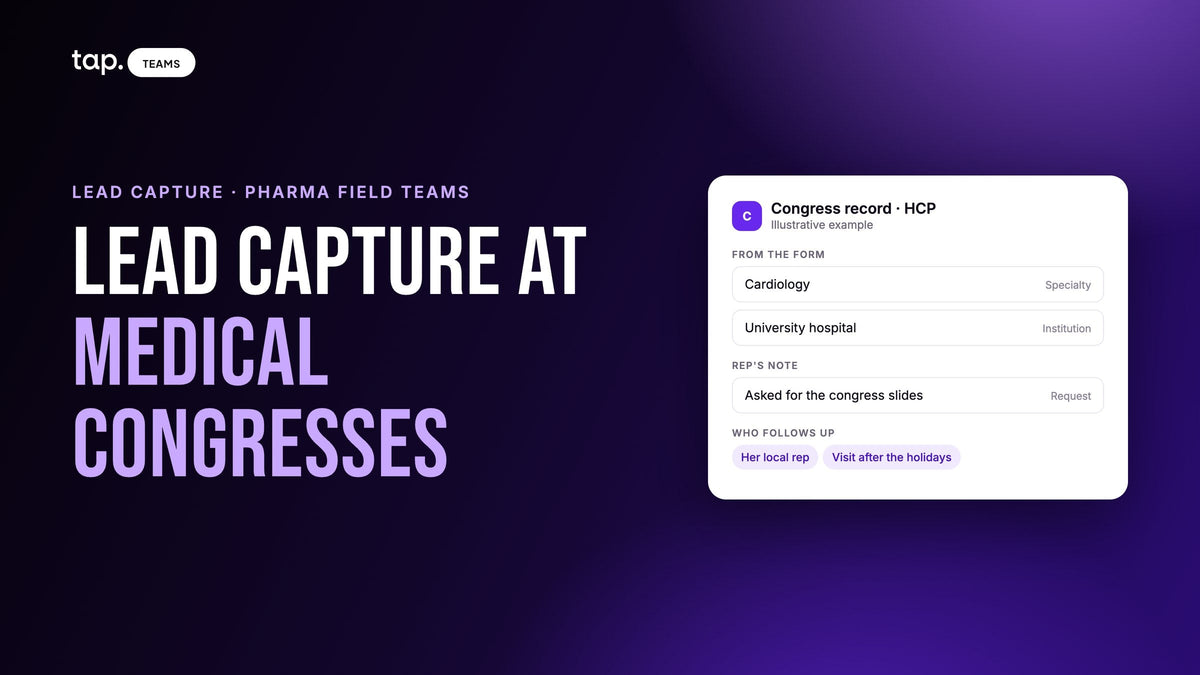
Lead capture at a medical congress works when you treat it as three jobs. Before the congress, agree what you may collect and who follows up each kind of contact. During it, give every real conversation with a healthcare professional a one-line note, at the booth, the symposium and the poster hall. Afterward, sort the list within a day.
This is a plan for the field team: the reps, their manager and whoever owns the booth. How the organizer's badge scanner works, and when to rent one, is in our guide to event lead retrieval. Getting the records into Vault CRM has its own article too: Veeva CRM lead capture.
Why a congress isn't a trade show
At a trade show the visitor is a buyer, and the lead is a possible deal. At a congress the visitor is a healthcare professional (HCP) who came for the science. What your rep walks away with is usually a request: send me the slides, ask your local rep to visit, I'd like to talk to someone on the medical side.
Those requests don't all belong to the rep who heard them. Some are for the HCP's own territory rep. Some are scientific and, in many companies, go to the medical team. At an international congress, some of the people at your booth practice in a country your team doesn't cover at all.
The rules are tighter too. The organizer sets how exhibitors may collect delegate data, and your own compliance team decides what a rep may write down about an HCP. Those rules differ by country, company and congress, so the plan below marks where to ask.

Before the congress: five things to settle
Most congress leads that go nowhere were lost before anyone traveled, in decisions nobody made. Give each of these an owner about two weeks out.
- Take the form, its consent wording and the note field to your compliance or medical-legal team, and ask what a rep may record about a conversation. Get the answer in writing.
- Read the data section of the exhibitor manual: where badge scanning is permitted, whether you may run your own form at the booth, and what the organizer's export contains.
- Agree who follows up whom: HCPs in your territories, HCPs a colleague already looks after, medical questions, and visitors from other countries.
- Keep the form to name, email, institution, specialty and country, plus one question about what they'd like next. Country earns its place because it decides who may follow up. Our guide to lead capture form design covers the rest.
- Decide who records each conversation. If it's the rep who had it, leave a minute between visitors on the rota. If it's a second person, say so.
Then test. Capture one lead on the venue network on setup day, and agree the congress tag name so nobody invents their own spelling.
At the congress: capture changes with the place
| Where | How to capture | What to watch |
|---|---|---|
| Booth | Your form on their phone, or the organizer's badge scan with your note added | A scan records a visit and nothing about the request |
| Symposium | The organizer's door scan for attendance, if your contract includes it; your form for the people with a question | Attending a session isn't asking to be contacted |
| Poster hall | A request to send the poster or reach an author, routed the way your company says | These are scientific conversations; check who should hold them |
| Corridors and dinners | A business card, or your own contact page shared from your phone | There's no scanner, so the note is all you have |
The booth
Decide the default before the doors open. If the organizer's scanner is the sanctioned route to delegate data, scan the badge and add your own note on top. If you may run your own form, let the HCP fill it in on their phone, so they type their own email and read the consent wording themselves.
Either way, the record isn't finished until the note is on it, and the time to write it is before the next visitor arrives. When three colleagues stop together, record the one who asked for something and leave the other two alone.
The symposium
If your company sponsors a session, the organizer may offer a badge scan at the door and send you an attendance list afterward. Treat that list as attendance only. The people worth a record are the few who come to the front with a question when the session ends. Have someone there with the form ready, and a colleague from medical beside them for the scientific questions.
The poster hall
Poster conversations are about data, and the person from your company at the poster is often from the medical or clinical team. I'd keep lead forms out of it. Ask beforehand who records poster requests and how. Often the request is for a copy of the poster or a word with an author, and it follows your company's route for scientific exchange.
Corridors and dinners
Good conversations happen in the coffee queue, where nobody has a scanner. Take the card or share your own contact page, then write the note that evening. By breakfast you won't remember which of two cardiologists asked for the slides.
What to record about an HCP conversation
A badge scan tells you who stopped. The follow-up comes from the note, which is also the part your compliance team will read most carefully. Keep it to facts the HCP would recognize if they saw it.
- Who they are: name, institution, specialty and country, mostly from the form or the badge
- What they asked for, in their words where you can
- What you promised, and by when
- Who should follow up: you, their own rep, medical, or another country's team
- That they agreed to be contacted, if the form doesn't already record it
A good note is short: "Asked for the congress slides. Wants a visit from her local rep after the holidays. Works at two sites; the university hospital is the main one."

Some things stay out unless your compliance team has said otherwise: anything about an identifiable patient, and your own opinion of the HCP. If an HCP asks about a use that isn't on the label, or mentions something that happened to a patient on your product, the lead note isn't the place for the details. Your company will have a process for medical information requests and safety reports. Use it, and write only "passed to medical" on the record.
The same goes for recording. Don't record a conversation with an HCP unless your compliance team has approved it for this congress, and then ask each person before you start.
After the congress: sort by who follows up
Do this on the first working day back, while the reps still remember faces. An ordinary lead list gets sorted by score. I'd sort a congress list by owner first, because the usual failure is a good request sitting with someone who can't act on it.
| The record | Goes to | First move |
|---|---|---|
| Asked for something, and is in your territory | The rep who met them | Send exactly what was asked for, and mention the conversation |
| Already has a rep at your company | That rep | Pass the note on, so the HCP hears from the person they know |
| Asked a medical or scientific question | The medical team, through your company's process | Hand it over the same day and note that you did |
| Practices in a country you don't cover | That country's team, if your company allows the handover | Send the record and the note together |
| Badge scan or attendance only | Marketing, or nobody | Only what the consent they gave covers |
Say your team comes back with 200 records (the numbers are made up to show the shape). Sorted this way, you might find 60 with a real request and 90 that are scans with no note, with the rest belonging to colleagues, medical or other countries. The 60 are this week's work.
Inside each rep's pile, the order is the usual one: promises first, then anyone who named a date. Our article on which trade show leads to call first has the timeline. One caution on scores: most lead scores reward a senior job title and a company email. Among HCPs a title says little, and some give a personal address, so read the request before the number.
When someone asks whether the congress was worth it, count the conversations that carried a request and how many of those people got what they asked for. Scan totals mostly tell you where the booth stood.
How Tap handles this
Tap is a capture app the rep carries on their own phone. The HCP opens the rep's profile with an NFC tap, a QR code or a link and fills in the form in their browser, with nothing to install; the collecting leads docs show the flow. An admin can put the capture fields on a template so every rep collects the same ones, and a custom question such as specialty sits next to the built-in ones. When a form isn't practical, the scanner has modes for business cards, QR codes and event badges, and for a card it shows what it read before saving. Test the badge mode on a real badge before you rely on it.
Captures made while the phone is offline sync when it reconnects. A rep can type a note on the lead or record a voice note that gets transcribed and summarized, and a note can carry a task with a due date and a reminder. Back at the office, you filter to the congress dates in Tap Teams, tag those leads in bulk and reassign the ones that belong to a colleague. The list exports with your filters applied.
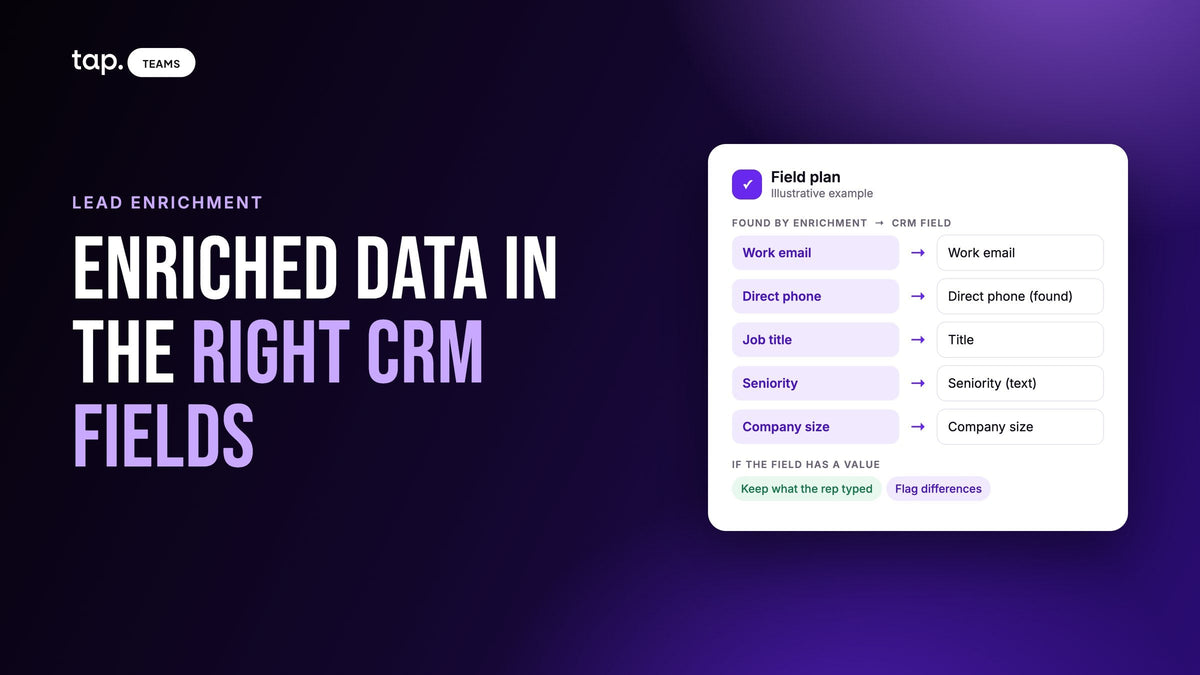
For teams on Vault CRM there's a native Veeva Vault connector: a captured lead becomes a contact record, owned by the rep who captured it when their email matches a Vault user. Sync Notes is on by default for a new CRM connection, so switch it off if note text shouldn't leave Tap. The docs are plain that compliance and recording consent stay with you.
The lead capture page covers the form and the scanner, or book a demo and bring your congress calendar.
FAQ
How does congress lead retrieval work for pharma exhibitors?
The congress organizer, or its registration contractor, licenses exhibitors a scanner or an app that reads delegate badges and releases the registration details for each scan. The export records who stopped at the booth. What they asked for has to come from your own note or form.
Is there an alternative to the congress organizer's lead scanner?
Often, yes: your own capture form or app, where the HCP types their details on their phone, used alongside the rented scanner or in place of it. Check the exhibitor manual first, because an organizer can make its scanner the only permitted way to collect delegate data. Tap's lead capture is one option, and our comparison of lead capture apps for trade shows covers others.
What should a pharma rep record about an HCP at a medical congress?
Who they are, what they asked for, what you promised and who should follow up. Keep patient details, opinions and the content of medical questions out of the note, and confirm with your compliance team what's allowed before the congress.
Can exhibitors scan HCP badges at a medical congress?
That depends on the organizer's rules and your company's. Many congresses offer exhibitors a badge scanner for the booth. Whether you may scan anywhere else, and what you may do with the data, is in the exhibitor manual. Ask the HCP before you scan.

Leave a comment
This site is protected by hCaptcha and the hCaptcha Privacy Policy and Terms of Service apply.